
JUMO Control Systems
Technical Highlights:
- Temperature, pressure, and flow controllers: compact, programmable devices with real-time start, GDPR-compliant data loggers, and interfaces like Modbus RTU/TCP.
Why choose JUMO controllers?
- Proven across industries such as energy, food, water, and wastewater technology.
- Scalable automation systems with highest flexibility and modern software architecture.
- Future-proof interfaces (EtherCAT, OPC UA, MQTT) and modular expandability for growing requirements.
JUMO AQUIS Controllers – Precise Control for Water, Environment & Industry
The JUMO AQUIS series offers reliable controllers for monitoring pH, conductivity, redox, oxygen, and more — ideal for water treatment, aquaculture, agriculture, and industrial processes. Featuring mobile operation and integrated data logging.

The instrument is used for conductive measurement / control of the electrolytic conductivity, the resistivity or the TDS value. In addition, the JUMO AQUIS 500 CR offers the possibility of displaying the measured conductivity according to a customer-specific table. display.Both conductive two-electrode and four-electrode measuring cells can be connected to the device. The temperature measurement is carried out as a second input variable with a Pt100/1000. Depending on the measured variable, specific automatic temperature compensation is possible.The unit is operated via keys and a large LC graphic display. This display makes it easy to read the measured value. The display of the parameters in plain text simplifies configuration for the operator and supports correct programming of the unit.The modular design of the unit allows it to be adapted to the requirements of the application. Up to four outputs are available.Typical areas of application:Universally applicable in water and wastewater management, service water, process water and wastewater, drinking, well and surface water, pure and ultrapure water applications, pharmaceutical water applications (e.g. according to USP, Ph.Eur., WFI), water quality measurements, TDS measurements (ppm or mg/l).Special features Direct switching option to specific - specific conductivity (µS/cm or mS/cm) - specific resistance (kΩ x cm or MΩ x cm) - TDS measurement (ppm or mg/l) - customer-specific tableAutomatic temperature compensation: off (e.g. USP), linear, ASTM, natural waters (EN 27888/ISO 7888)Large LC graphic display with backlightingDisplay presentation selectable: large digits, bargraph or tendency displayCalibration options depending on measured variable: cell constant and temperature coefficientCalibration logbookConnection possibility of two-electrode measuring cells (standard) or four-electrode measuring cellsActivatable contamination detection Autorange operation Protection class IP67 for surface mounting Protection class IP65 for control cabinet mountingOperator languages switchable: German, English, French; other languages via setup program RechargeableThrough setup program: convenient programming, system documentation, Loading of further operator languages JUMO Controllers – Precise Control for Various Processes JUMO controllers, especially from the modular AQUIS 500 series, provide reliable and flexible solutions for automated process control in water treatment, industry, and environmental technology. They are available for various measurement parameters such as temperature, pH, redox, conductivity, and oxygen, offering easy operation and high accuracy. At HeylNeomeris, you’ll find compact and modular JUMO controllers from the AQUIS 500 series, known for their robust design, multiple interface options, and flexible configuration possibilities. Why choose JUMO controllers: • Precise process control for optimal results • Durable and reliable even in demanding conditions • Easy integration into existing systems thanks to multiple interfaces • User-friendly menus and extensive configuration options

Version 2: stock version: type 202560/20-888-000-310-000-23/000 ; part-no. 00480050 The unit is used for measuring/controlling the pH-value, the redox-voltage or the NH3-(ammonia)-concentration. The function can be switched directly on the unit. Depending on the measurand, combination electrodes (e.g. pH/redox combination electrodes, gas-sensitive sensors) or separate versions (glass/metal electrodes with separate reference electrode) can be connected. The second input variable is the temperature measurement, which can be carried out with a Pt 100/1000, for example. Automatic temperature compensation is thus possible for the measured variables pH value and NH3. The units are operated via clear keys and a large LC graphic display. This display enables good readability of the measured value. The display of the parameters in plain text makes configuration easier for the operator and supports correct programming of the unit. The modular design of the unit allows it to be adapted to the requirements of the application. Up to four outputs are available. Special features direct switching option for pH value, redox voltage or NH3 (ammonia) concentration Automatic temperature compensation Large LC graphic display with backlighting Display selectable: large digits, bar graph or tendency display Solderless connection technology - Calibration options depending on measurand one/two/three-point calibration calibration logbook Impedance measurement can be activated for pH measurement Asymmetrical and symmetrical connection of pH sensors Possibility of connecting pH ISFET sensors through integrated output for sensor power supply Protection class IP67 for surface mounting, protection class IP65 for control cabinet mounting User languages switchable German, English, French; further languages can be loaded via setup program Through setup program: convenient programming, system documentation, reloading of further user languages JUMO AQUIS 500 – Modular Measuring and Control Systems for Precise Water Analysis The JUMO AQUIS 500 series includes a range of powerful, modular measuring and control devices for monitoring analytical water parameters such as pH, redox, conductivity, temperature, and more. Each model (e.g., AQUIS 500 pH, CR) is tailored to a specific sensor type or measurement range, making the series ideal for use in water treatment, environmental technology, process engineering, and industrial process monitoring. At HeylNeomeris, the AQUIS 500 series provides reliable solutions for stationary applications that demand high measurement accuracy, flexible system integration, and user-friendly operation. Advantages of the JUMO AQUIS 500 Series: • The series offers tailored solutions for various measurement tasks – from pH to conductivity • Modular design and compatibility allow for easy integration into existing systems • Digital interfaces (e.g., 0/4–20 mA, relay outputs) enable seamless automation • The devices deliver stable and precise measurements, even during continuous operation • A clear display and intuitive menu navigation simplify installation and maintenance • With IP65 protection and a robust design, they are well suited for industrial environments
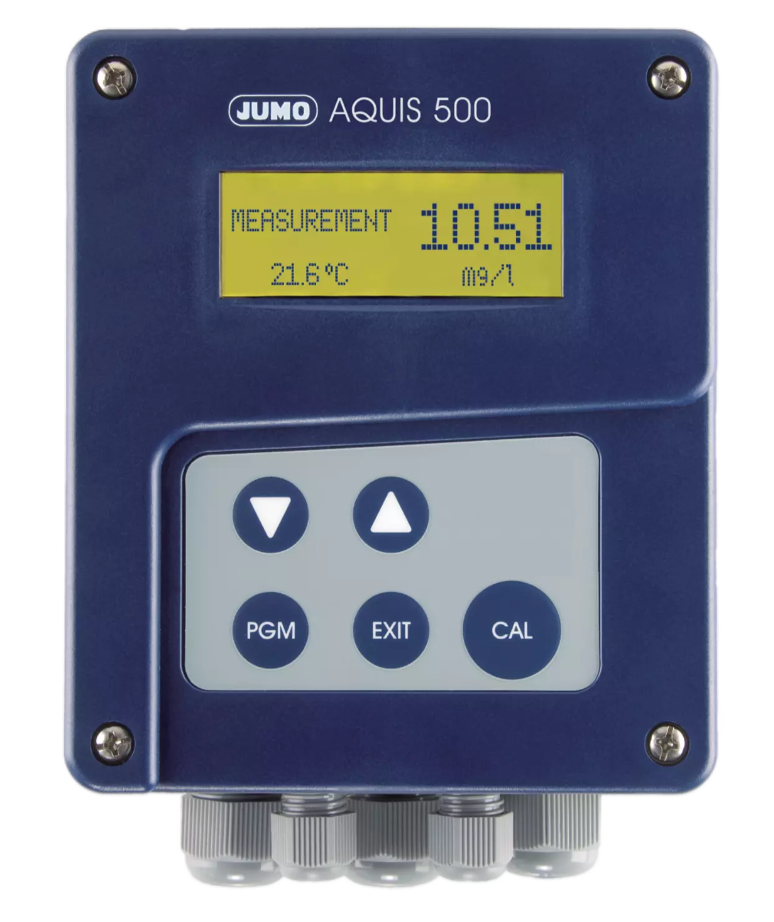
Indicator/controller for digital sensors with Modbus protocolThe unit has 1 digital interface, 1 analogue temperature input and 1 binary input. The digital interface is suitable for connecting sensors that have a Modbus RS485 interface. If the connected sensor does not have an integrated temperature sensor, a resistance thermometer Pt100, Pt1000 or NTC/PTC (up to 4 k) can be connected to the analogue temperature input. The power supply for the digital sensor is integrated in the unit.The LCD graphic display allows the input signals to be shown as digits or as a bar graph. The display of the parameters in plain text makes operation easy to understand and safe.With two optional relay change-over contacts, both simple switching or alarm functions and sophisticated control tasks with P, PI, PD and PID behaviour can be realised. On request, the unit can also be supplied with two freely parameterisable and scalable analogue outputs (0 to 10 V, or 0(4) to 20 mA).Special featuresDisplay: mg/l, ppm, % SAT, %, ‰, g/l, ppb, µg/l, NTU, FNU, etc.Special displays are also possible with the setup programmeLarge LCD graphic display with backlightingDisplay representation selectable: large digits, bargraph or trend displayIntegrated calibration routines:depending on the sensor: zero point, full scale and 2-pointCalibration logbookProtection class IP67 for surface mountingProtection class IP65 for control cabinet mountingOperator languages (switchable): German, English, Frenchthrough setup program (option): convenient programming, system documentation, reloading of additional operating languages

JUMO LOGOSCREEN 601 - paperless recorder with touch screen Basic type extension: without software package Option 1-3: not assigned Power supply: AC 110 bis 240 V +10/-15%, 48 bis 63 Hz Extra codes: not assigned Simple operation through intuitive touch operation Up to 2 analogue outputs Equipped with a PROFINET IO device interface (extra code) Integrated web server enables online visualisation as on the device Recording of batch protocols Limit value monitoring with 24 channels Optional flow measurement with 2 channels Optionally with 2 counter inputs (max. 12.5 kHz) Integration of own applications using structured text (ST code; with extra code) Automatic data readout via PCA communication software PCC Compliant data recording in accordance with FDA 21 CFR Part 11 (with extra code) Tamper detection via digital certificate (with extra code) PC programmes for data analysis and access control AMS2750/CQI-9 (extra code) Use for large operating temperature ranges The paperless recorder graphically displays systems and process statuses and protects process data acquisition against manipulation. Thanks to various connection configurations such as PROFINET, each with 24 analogue and digital inputs and outputs, it can be flexibly adapted to a wide range of requirements. Configuration and operation On the deviceWith the JUMO operating and visualisation concept, operation of the paperless recorder is almost intuitive for the user. The operating actions are carried out via a menu system based on symbols and executed via the touchscreen. The integrated user administration ensures that the paperless recorder is protected against unauthorised access. The basic version supports up to five users with individual access rights. The additional type 888 (FDA 21 CFR-Part 11) makes it possible to manage up to 50 users. With the setup programmeThe paperless recorder can also be configured via the setup programme, whereby some functions are only available within the setup programme, e.g: Adaptation of the operating language Assignment of user rights Creation of process screens Writing texts (e.g. for batch reports and process screens) The setup programme is installed on a PC with a Windows operating system (7/8/10 - 32 or 64 bit) and communicates with the display driver via USB or Ethernet interface. It is also possible to transfer configuration files to the display driver using a USB memory stick. The user has the option of saving the configuration data as a file and using it for documentation purposes. Operating languageThe device offers a selection of different operating languages. These languages can be edited and exchanged using the setup programme. The following languages are currently available: German English French, German Spanish Czech Chinese Russian Italian It is also possible to create your own language versions that are Unicode-capable. Process screen editorThe setup programme enables the user to create 6 customised process screens and transfer them to the paperless recorder. These screens are used to display process data and to enter text and process values. Each process screen can consist of up to 100 objects (images, analogue channels, digital channels, texts, ...). Interfaces USBThe paperless recorder is equipped with two USB interfaces as standard. A USB memory stick can be connected via the host interface on the front. The device interface on the rear (type Micro-B) is used to connect to a PC (for the setup programme or PCC/PCA3000). To ensure IP66 protection at the front, the USB host interface is fitted with a cover. EthernetThe screen driver is equipped with an Ethernet interface as standard, which supports various functions: Sending e-mails via SMTP server Time synchronisation via SNTP server Communication with a PC (setup programme, web server, data archiving with PCC/PCA3000) Communication with Modbus master/slave The IP address can be configured manually or set automatically by a DHCP server. The use of DNS is also supported. RS232/RS485 interfaces are also available. RS232/RS485This standard interface can be switched between RS232 and RS485 by configuration. It is used for communication with a Modbus master or Modbus slave. It is also intended for connecting a barcode scanner. PROFINET IO deviceThe paperless recorder can optionally be equipped with a PROFINET interface in order to integrate it into a PROFINET network as an IO device. This interface also enables the simultaneous use of standard Ethernet services, making the standard Ethernet interface superfluous. A GSD file (GSDML) is available for the programming system of the IO controller, which describes the properties of the paperless recorder. External inputs via interfaceThe interfaces (Ethernet, RS232/RS485) enable the paperless recorder to access 24 external analogue inputs and 24 external digital inputs. In addition, up to 10 texts for batch reports and 4 event texts with a length of up to 160 characters can be transmitted.In addition, up to 10 texts for batch reports and 4 event texts with a length of up to 160 characters can be transmitted using Modbus TCP and Modbus RTU. Inputs and outputsThe paperless recorder is available in different device variants with analogue and digital inputs and outputs (options). The analogue inputs (maximum 6) are versatile measurement inputs for: Resistance thermometers, thermocouples, resistance potentiometers/WFG, resistance/potentiometer Standard signals (current, voltage) Each of the up to 2 analogue outputs can be used flexibly either as a voltage output in the range from 0 to 10 V or as a current output with 0/4 to 20 mA.The digital inputs (maximum 12) and the individually switchable digital inputs/outputs (12) are operated with a voltage of DC 0/24 V.A relay output with changeover contact is available in every device variant, irrespective of the other specifications. Customer-specific linearisationIndividual linearisation according to customer requirements makes it possible to use sensor signals with special characteristics (e.g. PTC/NTC sensors, taking into account the resistance measuring range). Programming is carried out in the setup programme either using your value table with up to 40 value pairs or using a formula (4th order polynomial). The device supports 2 customer-specific linearisations. Data recordingThe measured values are recorded continuously with a sampling cycle of 125 ms. These measured values form the basis for creating reports and checking limit values. The measured values are transferred to the device's working memory depending on the programmable memory cycle and memory value: Current value Average value Maximum value Minimum value Min./Max. value The data is saved by the paperless recorder in groups, whereby a maximum of four groups can be assigned to each input. Working memory (SRAM)The data in the SRAM is regularly copied to the internal memory in blocks of 20 kilobytes each. Internal memory (Flasch)When a memory block in the main memory is full, the data is transferred to the internal memory, which has a maximum capacity of 1 GByte. Each write process is monitored in order to recognise errors immediately when saving data. The device continuously monitors the capacity of the internal memory and activates a memory alarm signal when a configurable residual capacity is reached, which can trigger the alarm relay, for example. The memory works on the principle of a ring buffer, so that when the memory is full, older data is automatically overwritten by new data. Data can be retrieved from the internal memory for the history display in the paperless recorder, whereby the history memory has a capacity of 8 MByte. Data transfer to the PCData can be transferred from the paperless recorder to a PC either via a USB memory stick or via one of the interfaces (USB device, Ethernet). Data securityThe data is encrypted and stored in a proprietary format, which ensures a high level of data security. In the event of disconnection from the power supply, the following conditions apply: Measurement data in the working memory and the time are buffered by a lithium battery (lithium battery life > 7 years) If the lithium battery discharges, the measurement data in the working memory and the time are lost. During battery replacement, the data is buffered for approx. 2 minutes by a storage capacitor. Measurement and configuration data in the internal memory are not lost. The device with the extra code 87 has a tamper detection function. Based on a digital device certificate, it is possible to prove that the register data in the device and during transfer to the data archive have not been manipulated. Recording durationThe maximum recording time is influenced by various factors, in particular the selected storage cycle. If a group with 6 analogue channels is activated in normal operation and the average values (not min/max values) are saved, the values in the table apply. Entries in the event list can reduce the maximum recording duration. ReportsReports (maximum, minimum and average values) can be recorded over defined periods of time for each channel in a group. The configuration is done individually for each group. Batch reportYou can use the paperless recorder to create a batch report for a system. The measurement data, the start, end and duration of the batch can be displayed together with a batch counter and freely definable texts both on the paperless recorder and in the PC evaluation software PCA3000. In addition, a barcode scanner can be used to control the start and stop of the batch and to read in batch texts. Recording GPS dataThe device can receive and record GPS data in NMEA-0183 format via its serial interface. The data from the connected GPS receivers, such as positioning data, is entered cyclically in the event list (group-related) and can therefore be analysed in conjunction with other recorded data. Operating modesThe operating mode can be selected individually for each group. The storage cycle and storage value can be set separately for each operating mode. Up to 4 groups can be recorded with a storage cycle of 125 ms. The operating modes have different priorities: Energy modeEvent operation is activated or deactivated via a control signal such as a digital input, a group or collective alarm. As long as the control signal is active, the device is in event mode, which has the highest priority. Timed operationTimed operation is active daily within an adjustable time window, provided no event operation is active. Normal modeIf the device is not in event or timed operation, normal operation is active. Limit value monitoringUp to 24 analogue values can be monitored using the adjustable limit value monitoring function. If the limit value is exceeded or not reached, an alarm signal is generated which can be used for individual purposes, for example to switch the operating mode from normal to event operation. With the help of an alarm delay, short-term over- or underruns can be faded out so that no alarm signal is triggered. It is also possible to suppress the alarm signal using a digital signal. Both the limit value and the switching differential can be adjusted during parameterisation. Counters/integratorsSix additional internal channels are available, which can be used as: Counter integrator Operating time counter Recording of a total flow rate can be used. Two high-speed counters with a frequency of up to 12.5 kHz can be realised using digital inputs/outputs 1 and 2 (optionally 3). These optional inputs are also required for flow measurement in order to analyse pulses from a flow transmitter.The counters are controlled by digital signals (counting pulses), while the integrators are operated by analogue signals (the value is integrated according to the selected time base).Operating time counters record the time period while a digital signal is active. The value of the counter/integrator is displayed numerically on the paperless recorder with a maximum of 9 digits. In the event of an overflow, the counter restarts at 0.Various recording periods can be set. A min. and max. alarm can be configured for each counter/integrator. Maths and logic module The maths and logic module (6 channels each) is available as an option. The maths function can be used to link various analogue and Boolean input variables using a freely definable formula with a maximum length of 160 ASCII characters. The output variables are real values. As an alternative to manual formula input, ready-made mathematical functions such as - Difference - ratio - Humidity - Moving average are available. The logic function makes it possible to link different Boolean values using a logic formula that can be up to 600ASCII characters long. The output variables are Boolean values. The maths and logic module is configured exclusively via the setup programme. Structured textThe "Structured text" option (extra code) allows the user to develop a customised application. This application is created using the ST editor, which is part of the setup programme, and uses the "Structured text" PLC programming language. Once completed, the application is transferred to the device and executed continuously. Online debugger functions are available in the ST editor for troubleshooting and testing. FDA-compliant data recordingWith extra code 888, the paperless recorder fully complies with FDA requirements in accordance with 21CFR Part 11. The PC software package (including PCS and PCAT) is required for user administration and commissioning. The device supports up to 50 users with specific rights. A user can sign a completed batch or the registration data of a specific time range with his electronic signature. Even when logging out, a registered user can provide a signature that is then valid for the entire period in which they were registered. Visualisation on the deviceThe paperless recorder offers various display types for visualising the measurement data. The visualisation images after the device is switched on can be selected in the configuration, as can the image that appears when the Home button is confirmed. Furthermore, the colours of the individual channels and the background colour of the analogue curves and digital traces can be set. Web serverThe paperless recorder has a web server function as standard. The web server enables the user to display the following settings, process values and messages with a web browser: Parameters at user level Customised process screens Factory visualisation Data from the recording function (including the history) Alarm and event lists The visualisation depends on the web browser used and the PC operating system. PC programmesThe paperless recorder is available with two different basic type extensions:Basic type 1: Contains the PC programmes o Setup o PCC o PCA3000 Basic type 888: In addition to the programmes mentioned above, also contains o PCS o PCAT See order details PCA communication software PCCThe PCA communication software PCC is a PC programme developed for Windows operating systems (7/8/10 - 32/65 bit). It is used to read out the data from the paperless recorder. The data can be read out either with a USB memory stick or via the interfaces (USB device, Ethernet). The data can be read out either manually or automatically, for example daily at 11.00 pm. PC evaluation software PCA3000The PC evaluation software PCA3000 is a PC program for Windows operating systems (7/8/10 - 32/64 bit) that is used to manage, archive, visualise and evaluate the data from the paperless recorder. The software recognises the data from various configured devices and saves it automatically in an archive database. Only an identifier (additional description) has to be assigned manually by the user. Users can access specific data records at any time, which can be differentiated using the identifier. It is also possible to restrict the time ranges to be analysed Any analogue and digital channels of a paperless recorder, even from different groups, can be subsequently combined in PCA3000 to form so-called PCA groups. Each group is displayed in its own window, allowing several groups to be displayed and compared on the screen at the same time The saved data can be exported using the export filter so that it can be processed in other programmes such as Excel. The PC evaluation software PCA3000 is network-compatible, which means that several users can access the data from the same archive file (*.177) in a network directory independently of each other. With the PCA300 option "automatic printout", in conjunction with the PCC software, batch data or reports can be automatically output to a printer or made available as a PDF file on the network. The output forms used can be customised. PC Security Manager PCSThe PCS software is used to manage access control for device users and is only available to administrators. This software can only be used with devices with the suffix 888. PC Audit Trail Manager PCATThe software is used to document PC operating actions that lead to changes in the data recording.

JUMO diraVIEW 108 - Digital indicator Typ: 701514/8-0000-23/000 Version: Standard with factory settings Power supply: AC 110-240 V +10/-15%, 48 to 63 Hz Option 1-4: not assigned Extra code: without 1 analogue input 2 digital inputs (digital input 1 as an alternative to logic output) 1 relay (normally open contact) 1 logic output 0/14 V (alternative to digital input 1) Display and storage of min/max values Tare function Hold function Tare function for weighing applications Customised linearisation with the option of defining up to 40 value pairs or a polynomial Timer function Monitoring of 4 limit values Customised user levels Optional customised application using structured text (ST code) Optional maths and logic function Simple installation thanks to push-in technology Optional analogue output Optional RS485 or Ethernet interface Additional analogue and digital inputs via the interface This digital indicator consists of five freely configurable and universally applicable devices in different DIN formats for displaying temperature, pressure and other process variables. The process variables and parameters are displayed on two 18-segment LCD displays. Types 701512, 701513 and 701514 are also equipped with a pixel matrix LCD display for displaying text. In addition, all devices have separate display elements for the switching positions of the outputs and the timer. They are operated via a membrane keypad with four buttons and are suitable for use in harsh environmental conditions thanks to their high IP65 protection rating. Inputs and outputs Each device type is equipped with a universal analogue input that is suitable for resistance thermometers, thermocouples, current, voltage, resistance transmitters and resistance/potentiometers. In addition, each device has a digital input, a switchable digital input/output. With the exception of type 701510, which has one relay output (normally open contact) as standard, all other types have two relay outputs (normally open contact). The digital inputs are designed for connection with a potential-free contact. The digital output provides a logic signal from 0 to 14 V. Furthermore, additional optional Relay outputs (normally open contact) Logic outputs (0 to 14 V) PhotoMOS® relay outputs Analogue output (0 to 10V / 0 to 20 mA) are available. Certain inputs and outputs cannot be used simultaneously (see notes in the connection diagram) Signal assignment via selectors The input signals and all internal signals are available in so-called selectors (analogue selector, digital selector) for further use in the device. The control signals for the outputs are also assigned via selectors, which enables flexible assignment of signals and functions. Interfaces The device has a USB device interface (Micro-B socket on the rear), which is specially designed for connection to a PC for the setup programme. During configuration, the device is supplied with power via this USB interface so that no mains supply is required. An optional RS485 interface is available, which is intended for communication with a Modbus master (Modbus RTU operating mode). The master can transmit up to two analogue values and two binary values to the device, which are used there as external input signals. In addition, two analogue flags and two digital flags (binary) are available. An Ethernet interface is also available as an option, which supports the Modbus TCP and Modbus RTU/ASCII operating modes via TCP. The same parameters and process values can be transmitted via this interface as via the RS485 interface. Power supply Two power supply variants are available: AC110 to 240 V AC/DC 20 to 30 V 48 to 63 Hz in each case Electrical connection Simple and time-saving connection using practical spring-loaded terminals (push-in technology) Min-max function Using the min-max function, the lowest and highest measured values are saved and continuously updated. It is possible to display these values separately or alternately with the current measured value. A binary signal makes it possible to reset the stored values and return them to the current measured value. Hold function The hold function "freezes" the value of the indicator, which means that this value is displayed for as long as the controlling binary signal is active. Tare function The tare function makes it possible to set the value of the indicator to zero, controlled by a binary signal (for weighing applications). The currently displayed value is added to the tare value each time. Another binary signal can be used to reset the tare value to zero so that the current value appears on the display again. Limit value monitoring The device has four limit value monitors, each with eight configurable alarm functions. Any analogue signal can be selected from a selector for monitoring. The limit values can either be absolute values or depend on another analogue signal. Various special functions are available, such as On/off delay Wiper function Alarm suppression during the switch-on phase or in the event of parameter changes Alarm latching Latching with acknowledgement available. These extensive functions enable flexible and precise realisation of alarm and limit value functions. Digital control signals This function enables the configuration of up to 4 digital control signals. The control signal is either formed by an AND/OR/XOR combination of up to three selectable binary signals or a single binary signal is used as an input signal and can be output as a pulsed signal, delayed signal, wiper signal or edge-triggered signal. In the latter case, the rising or falling edge of the binary signal is determined and the output signal is activated for the duration of a sampling interval. The output signal can be inverted in all these cases. Timer Once the timer is activated, an invertible signal is generated for the specified timer runtime. The timer can also be started after a lead time has elapsed or a tolerance limit has been reached. After the timer has elapsed, a timer end signal can be generated that is either time-limited or requires acknowledgement. These timer functions enable a wide range of time-dependent processes. Service counter The service counter can either count the number of switching operations of a binary signal or measure its switch-on duration. As soon as the adjustable limit value is reached, a binary signal is activated that must be acknowledged. An operating hours counter is also available, which records the operating time of the device. Maths and logic function The optional maths and logic function (extra code) can be used to link analogue or binary values. Up to four freely configurable maths or logic formulas can be created using the setup program. The results are then available for further use in the analogue or digital selector. Individual user level The individual user level offers space for up to 16 editable configuration parameters. These parameters can be selected individually in the setup programme. Setup programme With the setup programme, data records can be created, edited, transferred to the device and read out from there. The data can be saved and printed out. The programme also allows the user to easily create and print out a connection diagram showing the current terminal assignment of the device. Startup: The startup function enables the recording of process variables during commissioning for a maximum of 24 hours. The recorded diagrams are available on the PC and can be used for system documentation, for example. Online data: The current process variables of the device are displayed in a separate window. Customer-specific linearisation Individual linearisation according to customer requirements also makes it possible to use sensor signals with special characteristics. Programming is carried out in the setup program either using your value table with up to 40 value pairs or using a formula (4th order polynomial). The device supports 2 customer-specific linearisations. Structured text The "Structured text" option (extra code) allows the user to develop a customised application. This application is created using the ST editor, which is part of the setup programme, and uses the "Structured text" PLC programming language. Once completed, the application is transferred to the device and executed continuously. Online debugger functions are available in the ST editor for troubleshooting and testing. With the help of the ST code, it is possible to display up to 10 stored text messages depending on the application.

JUMO diraVIEW 108 - Digital indicator Version: Standard with factory settings Power supply: AC 110-240 V +10/-15%, 48 to 63 Hz Option 1-4: not assigned Extra code: without 1 analogue input 2 digital inputs (digital input 1 as an alternative to logic output) 2 relay (normally open contact) 1 logic output 0/14 V (alternative to digital input 1) Display and storage of min/max values Tare function Hold function Tare function for weighing applications Customised linearisation with the option of defining up to 40 value pairs or a polynomial Timer function Monitoring of 4 limit values Customised user levels Optional customised application using structured text (ST code) Optional maths and logic function Simple installation thanks to push-in technology Optional analogue output Optional RS485 or Ethernet interface Additional analogue and digital inputs via the interface This digital indicator consists of five freely configurable and universally applicable devices in different DIN formats for displaying temperature, pressure and other process variables. The process variables and parameters are displayed on two 18-segment LCD displays. Types 701512, 701513 and 701514 are also equipped with a pixel matrix LCD display for displaying text. In addition, all devices have separate display elements for the switching positions of the outputs and the timer. They are operated via a membrane keypad with four buttons and are suitable for use in harsh environmental conditions thanks to their high IP65 protection rating. Inputs and outputs Each device type is equipped with a universal analogue input that is suitable for resistance thermometers, thermocouples, current, voltage, resistance transmitters and resistance/potentiometers. In addition, each device has a digital input, a switchable digital input/output. With the exception of type 701510, which has one relay output (normally open contact) as standard, all other types have two relay outputs (normally open contact). The digital inputs are designed for connection with a potential-free contact. The digital output provides a logic signal from 0 to 14 V. Furthermore, additional optional Relay outputs (normally open contact) Logic outputs (0 to 14 V) PhotoMOS® relay outputs Analogue output (0 to 10V / 0 to 20 mA) are available. Certain inputs and outputs cannot be used simultaneously (see notes in the connection diagram) Signal assignment via selectors The input signals and all internal signals are available in so-called selectors (analogue selector, digital selector) for further use in the device. The control signals for the outputs are also assigned via selectors, which enables flexible assignment of signals and functions. Interfaces The device has a USB device interface (Micro-B socket on the rear), which is specially designed for connection to a PC for the setup programme. During configuration, the device is supplied with power via this USB interface so that no mains supply is required. An optional RS485 interface is available, which is intended for communication with a Modbus master (Modbus RTU operating mode). The master can transmit up to two analogue values and two binary values to the device, which are used there as external input signals. In addition, two analogue flags and two digital flags (binary) are available. An Ethernet interface is also available as an option, which supports the Modbus TCP and Modbus RTU/ASCII operating modes via TCP. The same parameters and process values can be transmitted via this interface as via the RS485 interface. Power supply Two power supply variants are available: AC110 to 240 V AC/DC 20 to 30 V 48 to 63 Hz in each case Electrical connection Simple and time-saving connection using practical spring-loaded terminals (push-in technology) Min-max function Using the min-max function, the lowest and highest measured values are saved and continuously updated. It is possible to display these values separately or alternately with the current measured value. A binary signal makes it possible to reset the stored values and return them to the current measured value. Hold function The hold function "freezes" the value of the indicator, which means that this value is displayed for as long as the controlling binary signal is active. Tare function The tare function makes it possible to set the value of the indicator to zero, controlled by a binary signal (for weighing applications). The currently displayed value is added to the tare value each time. Another binary signal can be used to reset the tare value to zero so that the current value appears on the display again. Limit value monitoring The device has four limit value monitors, each with eight configurable alarm functions. Any analogue signal can be selected from a selector for monitoring. The limit values can either be absolute values or depend on another analogue signal. Various special functions are available, such as On/off delay Wiper function Alarm suppression during the switch-on phase or in the event of parameter changes Alarm latching Latching with acknowledgement available. These extensive functions enable flexible and precise realisation of alarm and limit value functions. Digital control signals This function enables the configuration of up to 4 digital control signals. The control signal is either formed by an AND/OR/XOR combination of up to three selectable binary signals or a single binary signal is used as an input signal and can be output as a pulsed signal, delayed signal, wiper signal or edge-triggered signal. In the latter case, the rising or falling edge of the binary signal is determined and the output signal is activated for the duration of a sampling interval. The output signal can be inverted in all these cases. Timer Once the timer is activated, an invertible signal is generated for the specified timer runtime. The timer can also be started after a lead time has elapsed or a tolerance limit has been reached. After the timer has elapsed, a timer end signal can be generated that is either time-limited or requires acknowledgement. These timer functions enable a wide range of time-dependent processes. Service counter The service counter can either count the number of switching operations of a binary signal or measure its switch-on duration. As soon as the adjustable limit value is reached, a binary signal is activated that must be acknowledged. An operating hours counter is also available, which records the operating time of the device. Maths and logic function The optional maths and logic function (extra code) can be used to link analogue or binary values. Up to four freely configurable maths or logic formulas can be created using the setup program. The results are then available for further use in the analogue or digital selector. Individual user level The individual user level offers space for up to 16 editable configuration parameters. These parameters can be selected individually in the setup programme. Setup programme With the setup programme, data records can be created, edited, transferred to the device and read out from there. The data can be saved and printed out. The programme also allows the user to easily create and print out a connection diagram showing the current terminal assignment of the device. Startup: The startup function enables the recording of process variables during commissioning for a maximum of 24 hours. The recorded diagrams are available on the PC and can be used for system documentation, for example. Online data: The current process variables of the device are displayed in a separate window. Customer-specific linearisation Individual linearisation according to customer requirements also makes it possible to use sensor signals with special characteristics. Programming is carried out in the setup program either using your value table with up to 40 value pairs or using a formula (4th order polynomial). The device supports 2 customer-specific linearisations. Structured text The "Structured text" option (extra code) allows the user to develop a customised application. This application is created using the ST editor, which is part of the setup programme, and uses the "Structured text" PLC programming language. Once completed, the application is transferred to the device and executed continuously. Online debugger functions are available in the ST editor for troubleshooting and testing. With the help of the ST code, it is possible to display up to 10 stored text messages depending on the application.

JUMO eTRON T100 - electronic thermostat with timer function for mounting on 35 mm top-hat rails Version: Standard with factory settings Input: resistance thermometer Pt100, Pt1000, KTY2X-6 Power supply: AC 230 V +10/-15%, 48 to 63 Hz Option: Digital output PhotoMOS ® relay (connection of resistance thermometers in three-wire circuit is not possible) Extra code: without Available in 5 different measuring groups Intuitive operation and configuration both directly on the device and via the setup programme using the USB interface User area with 8 adjustable parameters Data logger functionality for recording measurement data Dot matrix display with 64 x 80 pixels and support for 4 national languages Service and operating hours counter for monitoring device utilisation Connection via PCB terminals with push-in technology for easy installation Use of 10A relays (changeover contacts) for reliable switching Option for customer-specific linearisation of the measurement results in the setup program Limit value monitoring for precise control and monitoring of processes Timer function for time-controlled execution of actions The digital thermostat measures the temperature using resistance thermometers, thermocouples or a current of 0(4) to 20 mA and can be configured as a simple heating or cooling thermostat depending on the selected mode. The thermostat function (heating or cooling) can be started or limited in time using the timer function. The switching states of the relay and digital output, as well as the actual and setpoint values, are shown simultaneously on a backlit display with a resolution of 64 x 80 pixels. The display language can be switched between German, English, French and Spanish. It is operated via four buttons on the front, while the electrical connection is made via print terminals with push-in technology. PhotoMOS® relays for limit value monitoring or a digital input for connecting a potential-free contact can be added as an option. A setup programme is available for easy configuration.

JUMO meroVIEW - Multifunction digital indicator with PLC function Version: Standard with factory settings Power supply: AC 10 to 240 V +10/-15% / 48 to 63 Hz Extra code: without Option1-6: not assigned 1 analogue input 1 digital input 1 digital input/output switchable 1 relay (NO contact) 2 timers Min/max display Hold function Tare function The display series comprises four universally applicable devices in various DIN formats, which are used to display temperature, pressure and other process variables.The devices offer user-friendly operation with a clearly structured layout and text support. Process values and parameters are displayed on two 18-segment LCD displays. Types 701552, 701553 and 701554 also have a pixel matrix LCD display for displaying texts. Additional display elements provide information about the switching positions of the outputs and certain functions such as timers. The devices are operated via a membrane keypad with 4 buttons and can also be used in demanding environments thanks to their high IP65 protection rating.The basic equipment already includes a min/max value display, hold function, temperature function, limit value monitoring, digital control signals, extensive timer functions and a service counter. Optionally, the devices can be extended with a maths and logic function as well as with ST code functionality to realise customer-specific functions. The ST code functionality also allows direct access to the display and operating buttons, which enables customised device operation. Inputs and outputsEach device type is equipped with a universal analogue input that is suitable for resistance thermometers, thermocouples, current, voltage, resistance transmitters and resistance/potentiometers. Each device also has a digital input, a switchable digital input/output and two relay outputs (NO contact 3 A). The digital inputs are intended for the connection of a potential-free contact, while the digital output supplies a logic signal of 0/14 V.The optional digital outputs with 0/14 V (not galvanically isolated) can be used, for example, to control solid-state relays. Alternatively, the optional digital outputs with 0/22 V and galvanic isolation can also be used as a voltage supply for two-wire transmitters.Please note that certain inputs and outputs cannot be used simultaneously (see notes in the wiring diagram). Customer-specific linearisationIndividual linearisation according to customer requirements also makes it possible to use sensor signals with special characteristics. Programming is carried out in the setup program either using your value table with up to 40 value pairs or using a formula (4th order polynomial). The device supports 2 customer-specific linearisations. Counting inputsThe device can optionally be equipped with up to 4 counting inputs, with a maximum counting frequency of 12.5 kHz. Each counting input can be controlled either with a digital signal of 0/24 V or via a potential-free contact. The counters allow the following functions to be configured: Counting of pulses Calculation of frequency speed Speed (volume per time unit) Flow rate (volume per time unit) In addition, individual functions can be implemented via maths functions or ST code, such as the calculation of the total flow rate (volume) Signal assignment via selectorsThe input signals and all internal signals are available in so-called selectors (analogue selector, digital selector) for further use in the device. The control signals for the outputs are also assigned via selectors, which enables flexible assignment of signals and functions. USB interfacesThe device has a USB device interface (Micro-B socket on the rear), which is intended exclusively for connection to a PC for use with the setup programme. There is also a USB host interface (type A socket), which is located on the rear of the 108 and 104 format devices and on the side of the smaller 116 format device. This interface is intended for connecting a USB memory stick in order to carry out firmware updates, read out data loggers and transfer the device configuration. RS485 interfaceThe RS485 interface is available as an option and supports the Modbus RTU protocol. It can be used in both master and slave mode. Ethernet interfaceThe Ethernet interface (Modbus TCP) is optional and enables parallel communication with 2x mater or 2x slave. It is used for integration into a company network, the transfer of process values and communication with the setup programme. PROFINET interfaceThe device can optionally be equipped with a PROFINET interface in order to be integrated into a PROFINET network as an IO device. A GSD file (GSDML) is available for the programming system of the IO controller, which describes the properties of the device. It should be noted that the standard Ethernet services are not supported via the PROFINET interface. If the device is equipped with the PROFINET interface, neither the Ethernet nor the RS485 interface can be used. Power supplyThe device is available in two power supply variants: AC 110 to 240 V or AC/DC 24 V (see Technical data). Electrical connectionThe electrical connection is time-saving with removable spring-loaded terminals (PushIn technology). Min-max functionWhen the min-max function is activated, both the minimum and maximum values of the indicator are saved and continuously updated. These values can be displayed separately or alternating with the current value. In the alternating display (scrolling), the min/max symbol is active while either the minimum or maximum value is displayed. A binary signal can be used to reset the stored values in order to return to the current value. Hold functionThe hold function "freezes" the value of the indicator, which means that this value is displayed as long as the controlling binary signal is active. Tare functionThe tare function makes it possible to set the value of the indicator to zero, controlled by a binary signal (for weighing applications). The currently displayed value is added to the tare value each time. Another binary signal can be used to reset the tare value to zero so that the current value appears on the display again. Limit value monitoringThe device is equipped with 8 limit value monitors, each of which has 8 configurable alarm functions. Any analogue signal is selected from a selector for monitoring, while the limit value can either be an absolute value or dependent on another analogue signal. It offers special functions such as On/off delay Wiper function Alarm suppression during the switch-on phase or in the event of parameter changes Alarm latching Latching with acknowledgement Limit value monitoring enables a variety of alarm and limit value functions. Digital control signalsThis function enables the configuration of up to 8 digital control signals. The control signal is either formed by an AND/OR/XOR combination of up to three selectable binary signals or a single binary signal is used as an input signal and can be output as a pulsed signal, delayed signal, wiper signal or edge-triggered signal. In the latter case, the rising or falling edge of the binary signal is determined and the output signal is activated for the duration of a sampling interval. The output signal can be inverted in all these cases. TimerThe device is also equipped with 2 timers that can be started via freely selectable digital signals or depending on an integrated tolerance band monitoring function. Lead and lag times as well as a self-hold function with acknowledgement are also available. This makes it easy to realise a wide range of functions such as time-controlled regulation or setpoint switching. Service counterThe service counter can either count the number of switching operations of a binary signal or measure its switch-on duration. As soon as the adjustable limit value is reached, a binary signal is activated and must be acknowledged. An operating hours counter is also available, which records the operating time of the device. Maths and logic functionThe optional maths and logic function (extra code) can be used to link analogue or binary values. Up to four freely configurable maths or logic formulas can be created using the setup program. The results are then available for further use in the analogue or digital selector. Structured textThe "Structured text" option (extra code) allows the user to develop a customised application. This application is created using the ST editor, which is part of the setup programme, and uses the "Structured text" PLC programming language. Once completed, the application is transferred to the device and executed continuously. Online debugger functions are available in the ST editor for troubleshooting and testing.With the setup programme, the user can also create up to 100 individual texts and have them shown on the device display by a corresponding application. These texts can be entered in four languages so that they are displayed in the respective language after changing the device language. Data loggerThe data logger enables the recording of 4 analogue and 4 binary values. The recording interval is adjustable and ranges from 1 minute to 1 hour. Recording is based on the ring memory principle, which means that older data is overwritten as soon as the memory is full. With a recording interval of 10 minutes, the data can be recorded for around 2 years before the oldest data is overwritten. A USB memory stick on which the data is stored in CSV format is used to read out the data. Real-time clockThe real-time clock provides the current date and time (time stamp for data logger and ST code). Retain memoryThanks to the integrated retain memory, specific data is retained even in the event of a power failure. This applies to the service data, the counter and timer data as well as the retain data of the ST code. Individually configurable operating levelsThe user has the option of customising the device menu to ensure a high level of operating convenience and optimum integration into the system. Four menu levels with submenus are available for this purpose. The menu items and parameters can be labelled individually in four languages, and it is possible to switch between them. The menu levels can be partially or completely locked to prevent unauthorised operation. Setup programmeThe setup programme is essential for commissioning the device and is available to download free of charge. In addition to the individual set-up of the operating levels, whose parameters can subsequently be edited in the device, the setup programme offers the user a simple and user-friendly method of configuring the device using a PC. With the setup programme, data records can be created, edited, transferred to the device and read out from there. The data can be saved and printed out. The programme also allows the user to easily create and print out a connection diagram showing the current terminal assignment of the device. Startup: The startup function enables the recording of process variables during commissioning for a maximum of 24 hours. The recorded diagrams are available on the PC and can be used for system documentation, for example. Online data: The current process variables of the device are displayed in a separate window. Firmware update The device's firmware can be updated in a user-friendly way using a USB memory stick; the file is provided by the manufacturer if required.

JUMO miro TRON - electronic thermostat with PID two-point controller option Typ: 701081/0-01-24-02/000 Input: 1 resistance thermometer Pt100, Pt1000 in two-wire circuit, 1 digital input Output: 4 relays (NO contact AC 250 V, 2.5 A), resistive load, only for type 701081 Power supply: AC 230 V, +10/-15 %, 48 to 63 Hz With max. 4 relays Version: Standard version Extra code: without The electronic thermostat is used as a heating or cooling thermostat, but can be optionally extended with a PID two-point controller option. The device offers user-friendly operation, characterised by a clear structure and supporting texts in German, English, French and Spanish. Process values, texts and parameters are displayed on two 18-segment LCD displays. Additional display elements provide information on the switching positions of the outputs, the status of the timer and the temperature unit used. PCB terminals with push-in technology enable quick electrical installation. Operation, parameterisation and configuration are carried out via a membrane keypad with four buttons. PID two-point controller (optional)If the PID two-point controller option is selected, various controller structures are available, including P, I, PH, PI and PID, which also enable self-optimisation. In addition, the setup programme offers a start-up function and a display of the online parameters. Inputs and outputsThe required analogue input can be selected when ordering: Resistance thermometer Thermocouple Current (4 to 20 mA) Voltage (0 to 10 V) There is also a digital input for connecting a potential-free contact (not for resistance thermometers in three-wire circuit). Depending on the device type, the following combinations are available as outputs: 2 relays (1 changeover contact, 1 NO contact), or 1 relay (NO contact) and 1 digital output DC 0/14 V, or 4 relays (NO contact). USB device interfaceThe device has a Micro-B socket, which is intended for connection to a PC for configuration with the setup programme. No separate power supply is required during configuration via the USB interface (USB-powered). Electrical connectionThe electrical connection is made in a time-saving manner using spring-loaded terminals (push-in technology) Self-optimisation Self-optimisation (oscillation method) makes it possible even for users with no knowledge of control technology to adapt the controller to the controlled system. The reactions of the controlled system to changes in the manipulated variable are analysed and certain controller parameters are calculated. Limit value monitoring The device has three limit value monitors, each of which offers eight configurable alarm functions. Any analogue signal is selected from a selector as the value to be monitored. The limit values can be defined either as an absolute value or as a different analogue signal. Additional functions: On/off delay - Wiper function Alarm suppression during the switch-on phase or when parameters are changed Alarm latching Latching with acknowledgement are available. Comprehensive alarm and limit value functions can be realised with limit value monitoring. TimerAfter the timer is activated, a signal is output for the preset runtime, which can be inverted. The timer can also be started after a lead time has elapsed or a tolerance limit has been reached. After the timer has elapsed, an end signal can be generated that is either limited in time or can be deactivated by acknowledgement. The timer makes it possible, for example, to realise a time-controlled setpoint changeover. Service counterThe service counter can either count the number of switching operations of a binary signal or measure its switch-on duration. As soon as the adjustable limit value is reached, a binary signal is activated that must be acknowledged. An operating hours counter is also available, which records the operating time of the device. Setup programmeThe optional setup programme allows the user to configure the device easily and conveniently via a PC. With this programme, data can be created, edited, transferred to the device and read out from there. It also offers a recording function for commissioning (start-up). Customer-specific linearisationIndividual linearisation according to customer requirements makes it possible to use sensor signals with special characteristics. Programming is carried out in the setup programme either using your value table with up to 40 value pairs or using a formula (4th order polynomial)

JUMO miro TRON - electronic thermostat with PID two-point controller option Input: 1 resistance thermometer Pt100, Pt1000 in two-wire circuit, 1 digital input Output: 1 relay (changeover contact AC 250 V, 10 A) and 1 relay (NO contact AC 250 V, 5 A), resistive load Power supply: AC 230 V+10/-15%, 48 bis 63 Hz Version: Standard version Extra code: without The electronic thermostat is used as a heating or cooling thermostat, but can be optionally extended with a PID two-point controller option. The device offers user-friendly operation, characterised by a clear structure and supporting texts in German, English, French and Spanish. Process values, texts and parameters are displayed on two 18-segment LCD displays. Additional display elements provide information on the switching positions of the outputs, the status of the timer and the temperature unit used. PCB terminals with push-in technology enable quick electrical installation. Operation, parameterisation and configuration are carried out via a membrane keypad with four buttons. PID two-point controller (optional)If the PID two-point controller option is selected, various controller structures are available, including P, I, PH, PI and PID, which also enable self-optimisation. In addition, the setup programme offers a start-up function and a display of the online parameters. Inputs and outputsThe required analogue input can be selected when ordering: Resistance thermometer Thermocouple Current (4 to 20 mA) Voltage (0 to 10 V) There is also a digital input for connecting a potential-free contact (not for resistance thermometers in three-wire circuit). Depending on the device type, the following combinations are available as outputs: 2 relays (1 changeover contact, 1 NO contact), or 1 relay (NO contact) and 1 digital output DC 0/14 V, or 4 relays (NO contact). USB device interfaceThe device has a Micro-B socket, which is intended for connection to a PC for configuration with the setup programme. No separate power supply is required during configuration via the USB interface (USB-powered). Electrical connectionThe electrical connection is made in a time-saving manner using spring-loaded terminals (push-in technology) Self-optimisationSelf-optimisation (oscillation method) makes it possible even for users with no knowledge of control technology to adapt the controller to the controlled system. The reactions of the controlled system to changes in the manipulated variable are analysed and certain controller parameters are calculated. Limit value monitoringThe device has three limit value monitors, each of which offers eight configurable alarm functions. Any analogue signal is selected from a selector as the value to be monitored. The limit values can be defined either as an absolute value or as a different analogue signal. Additional functions: On/off delay Wiper function Alarm suppression during the switch-on phase or when parameters are changed Alarm latching Latching with acknowledgementare available. Comprehensive alarm and limit value functions can be realised with limit value monitoring. TimerOnce the timer has been activated, a signal is emitted for the preset runtime, which can be inverted. The timer can also be started after a lead time has elapsed or a tolerance limit has been reached. After the timer has elapsed, an end signal can be generated that is either limited in time or can be deactivated by acknowledgement. The timer makes it possible, for example, to realise a time-controlled setpoint changeover. Service counterThe service counter can either count the number of switching operations of a binary signal or measure its switch-on duration. As soon as the adjustable limit value is reached, a binary signal is activated that must be acknowledged. An operating hours counter is also available, which records the operating time of the device. Setup programmeThe optional setup programme allows the user to configure the device easily and conveniently via a PC. With this programme, data can be created, edited, transferred to the device and read out from there. It also offers a recording function for commissioning (start-up). Customer-specific linearisationIndividual linearisation according to customer requirements makes it possible to use sensor signals with special characteristics. Programming is carried out in the setup programme either using your value table with up to 40 value pairs or using a formula (4th order polynomial)
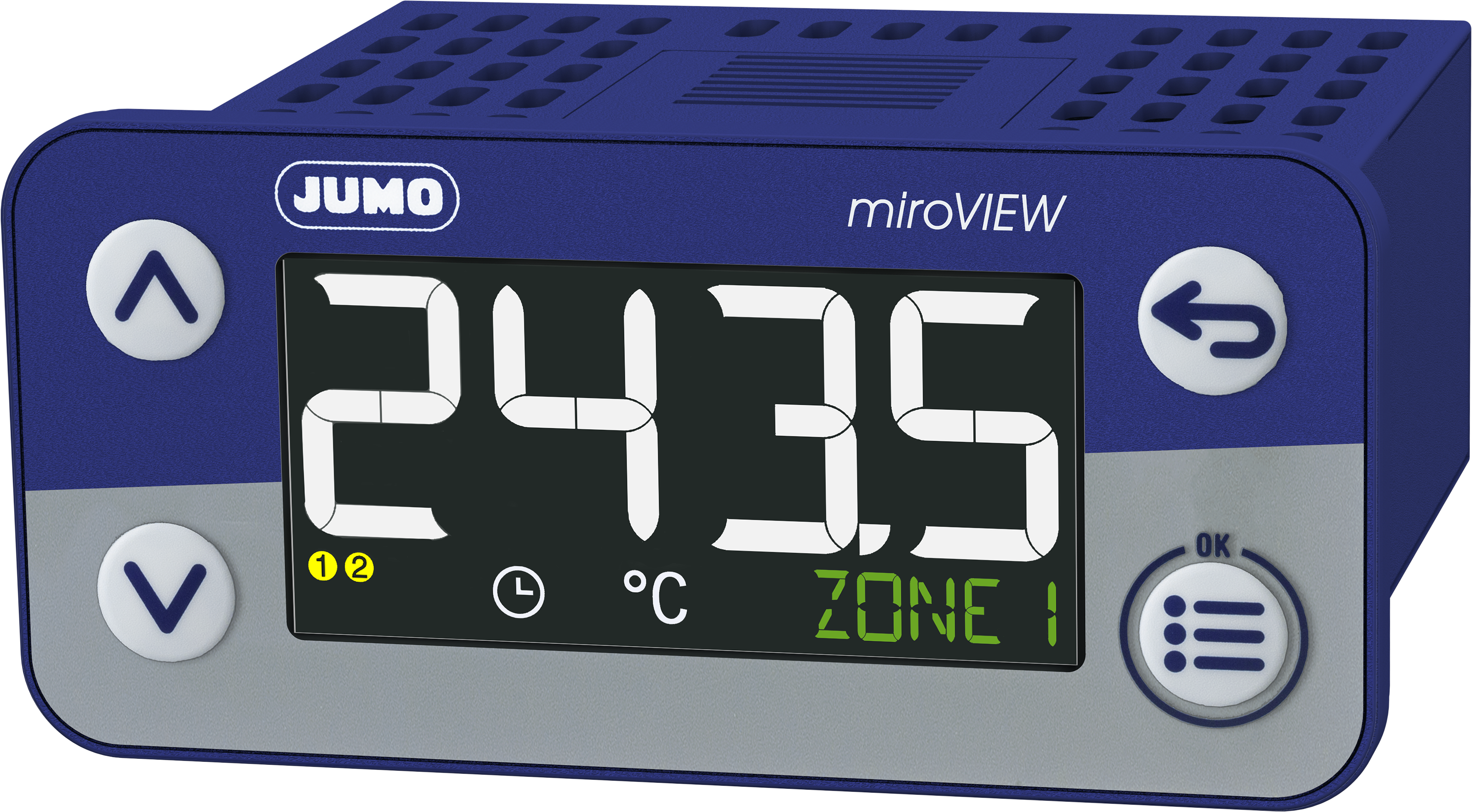
JUMO miro VIEW - smart digital indicator with limit value monitoring Input: 1 resistance thermometer Pt100, Pt1000 in two-wire circuit, 1 digital input Output: 1 relay (changeover contact AC 250 V, 10 A) and 1 relay (make contact AC 250 V, 5 A) resistive load Power supply: AC 230 V +10/-15 %, 48 to 63 Hz The smart digital indicator is used to electronically display various process variables. The device records the process variables via resistance thermometer, thermocouple, current 0(4) to 20 mA or voltage 0 to 10 V. Other functions include limit value monitoring, min/max value storage, hold function and tare function. The device can be supplied either with 2 relays or with 1 relay and 1 digital output (DC0/14 V). It is characterised by user-friendly, clear operation in German, English, French and Spanish. Process values, texts and parameters are displayed on two 18-segment LCD displays. Additional display elements provide information about Switching positions of the outputs Status of the timer Temperature unit PCB terminals with push-in technology enable quick electrical installation. Operation, parameterisation and configuration are carried out via a membrane keypad with four buttons. Display functionIn addition to the conventional display of the measured value, the device offers additional functions such as Display of min/max values Hold function to hold the current measured value Tare function for weighing applications Some of these functions can be configured using the membrane keypad on the front. Inputs and outputsThe required analogue input can be selected when ordering: Resistance thermometer Thermocouple Current (4 to 20 mA) Voltage (0 to 10 V) There is also a digital input for connecting a potential-free contact (not for resistance thermometers in three-wire circuit). Depending on the device type, the following combinations are available as outputs: 2 relays (1 changeover contact, 1 NO contact), or 1 relay (NO contact) and 1 digital output DC 0/14 V, or 4 relays (NO contact). USB device interfaceThe device has a Micro-B socket that is intended for connection to a PC for configuration with the setup programme. No separate power supply is required during configuration via the USB interface (USB-powered). Electrical connectionThe electrical connection is made using time-saving spring-loaded terminals (push-in technology) Limit value monitoringThe device has three limit value monitors, each of which offers two configurable alarm functions. Any analogue signal is selected from a selector as the value to be monitored. The limit values can be defined either as an absolute value or as a different analogue signal. Additional functions: On/off delay Wiper function Alarm suppression during the switch-on phase or when parameters are changed Alarm latching Latching with acknowledgement are available. Comprehensive alarm and limit value functions can be realised with limit value monitoring. TimerAfter the timer is activated, a signal is output for the preset runtime, which can be inverted. The timer can also be started after a lead time has elapsed or a tolerance limit has been reached.The service counter is used either to count the switching frequency of a binary signal or to determine its switch-on duration. As soon as the adjustable limit value is reached, a binary signal is activated and must be acknowledged. An operating hours counter is also available, which records the operating time of the device. Setup programmeThe optional setup programme enables the user to configure the device easily and conveniently via a PC. With this programme, data can be created, edited, transferred to the device and read out from there. It also offers a recording function for commissioning (start-up). Customer-specific linearisationIndividual linearisation according to customer requirements makes it possible to use sensor signals with special characteristics. Programming is carried out in the setup programme either using your value table with up to 40 value pairs or using a formula (4th order polynomial)

JUMO diraVIEW 116 - Digital indicator Version: Standard with factory settings Power supply: AC 110-240 V +10/-15%, 48 to 63 Hz Option 1-4: not assigned Extra code: without 1 analogue input 2 digital inputs (digital input 1 as an alternative to logic output) 2 relay (normally open contact) 1 logic output 0/14 V (alternative to digital input 1) Display and storage of min/max values Tare function Hold function Tare function for weighing applications Customised linearisation with the option of defining up to 40 value pairs or a polynomial Timer function Monitoring of 4 limit values Customised user levels Optional customised application using structured text (ST code) Optional maths and logic function Simple installation thanks to push-in technology Optional analogue output Optional RS485 or Ethernet interface Additional analogue and digital inputs via the interface This digital indicator consists of five freely configurable and universally applicable devices in different DIN formats for displaying temperature, pressure and other process variables. The process variables and parameters are displayed on two 18-segment LCD displays. Types 701512, 701513 and 701514 are also equipped with a pixel matrix LCD display for displaying text. In addition, all devices have separate display elements for the switching positions of the outputs and the timer. They are operated via a membrane keypad with four buttons and are suitable for use in harsh environmental conditions thanks to their high IP65 protection rating. Inputs and outputs Each device type is equipped with a universal analogue input that is suitable for resistance thermometers, thermocouples, current, voltage, resistance transmitters and resistance/potentiometers. In addition, each device has a digital input, a switchable digital input/output. With the exception of type 701510, which has one relay output (normally open contact) as standard, all other types have two relay outputs (normally open contact). The digital inputs are designed for connection with a potential-free contact. The digital output provides a logic signal from 0 to 14 V. Furthermore, additional optional Relay outputs (normally open contact) Logic outputs (0 to 14 V) PhotoMOS® relay outputs Analogue output (0 to 10V / 0 to 20 mA) are available. Certain inputs and outputs cannot be used simultaneously (see notes in the connection diagram) Signal assignment via selectors The input signals and all internal signals are available in so-called selectors (analogue selector, digital selector) for further use in the device. The control signals for the outputs are also assigned via selectors, which enables flexible assignment of signals and functions. Interfaces The device has a USB device interface (Micro-B socket on the rear), which is specially designed for connection to a PC for the setup programme. During configuration, the device is supplied with power via this USB interface so that no mains supply is required. An optional RS485 interface is available, which is intended for communication with a Modbus master (Modbus RTU operating mode). The master can transmit up to two analogue values and two binary values to the device, which are used there as external input signals. In addition, two analogue flags and two digital flags (binary) are available. An Ethernet interface is also available as an option, which supports the Modbus TCP and Modbus RTU/ASCII operating modes via TCP. The same parameters and process values can be transmitted via this interface as via the RS485 interface. Power supply Two power supply variants are available: AC110 to 240 V AC/DC 20 to 30 V 48 to 63 Hz in each case Electrical connection Simple and time-saving connection using practical spring-loaded terminals (push-in technology) Min-max function Using the min-max function, the lowest and highest measured values are saved and continuously updated. It is possible to display these values separately or alternately with the current measured value. A binary signal makes it possible to reset the stored values and return them to the current measured value. Hold function The hold function "freezes" the value of the indicator, which means that this value is displayed for as long as the controlling binary signal is active. Tare function The tare function makes it possible to set the value of the indicator to zero, controlled by a binary signal (for weighing applications). The currently displayed value is added to the tare value each time. Another binary signal can be used to reset the tare value to zero so that the current value appears on the display again. Limit value monitoring The device has four limit value monitors, each with eight configurable alarm functions. Any analogue signal can be selected from a selector for monitoring. The limit values can either be absolute values or depend on another analogue signal. Various special functions are available, such as On/off delay Wiper function Alarm suppression during the switch-on phase or in the event of parameter changes Alarm latching Latching with acknowledgement available. These extensive functions enable flexible and precise realisation of alarm and limit value functions. Digital control signals This function enables the configuration of up to 4 digital control signals. The control signal is either formed by an AND/OR/XOR combination of up to three selectable binary signals or a single binary signal is used as an input signal and can be output as a pulsed signal, delayed signal, wiper signal or edge-triggered signal. In the latter case, the rising or falling edge of the binary signal is determined and the output signal is activated for the duration of a sampling interval. The output signal can be inverted in all these cases. Timer Once the timer is activated, an invertible signal is generated for the specified timer runtime. The timer can also be started after a lead time has elapsed or a tolerance limit has been reached. After the timer has elapsed, a timer end signal can be generated that is either time-limited or requires acknowledgement. These timer functions enable a wide range of time-dependent processes. Service counter The service counter can either count the number of switching operations of a binary signal or measure its switch-on duration. As soon as the adjustable limit value is reached, a binary signal is activated that must be acknowledged. An operating hours counter is also available, which records the operating time of the device. Maths and logic function The optional maths and logic function (extra code) can be used to link analogue or binary values. Up to four freely configurable maths or logic formulas can be created using the setup program. The results are then available for further use in the analogue or digital selector. Individual user level The individual user level offers space for up to 16 editable configuration parameters. These parameters can be selected individually in the setup programme. Setup programme With the setup programme, data records can be created, edited, transferred to the device and read out from there. The data can be saved and printed out. The programme also allows the user to easily create and print out a connection diagram showing the current terminal assignment of the device. Startup: The startup function enables the recording of process variables during commissioning for a maximum of 24 hours. The recorded diagrams are available on the PC and can be used for system documentation, for example. Online data: The current process variables of the device are displayed in a separate window. Customer-specific linearisation Individual linearisation according to customer requirements also makes it possible to use sensor signals with special characteristics. Programming is carried out in the setup program either using your value table with up to 40 value pairs or using a formula (4th order polynomial). The device supports 2 customer-specific linearisations. Structured text The "Structured text" option (extra code) allows the user to develop a customised application. This application is created using the ST editor, which is part of the setup programme, and uses the "Structured text" PLC programming language. Once completed, the application is transferred to the device and executed continuously. Online debugger functions are available in the ST editor for troubleshooting and testing. With the help of the ST code, it is possible to display up to 10 stored text messages depending on the application.

JUMO diraVIEW 132 - Digital indicator Version: Standard with factory settings Power supply: AC 110-240 V +10/-15%, 48 to 63 Hz Option 1-4: not assigned Extra code: without 1 analogue input 2 digital inputs (digital input 1 as an alternative to logic output) 1 relay (normally open contact) 1 logic output 0/14 V (alternative to digital input 1) Display and storage of min/max values Tare function Hold function Tare function for weighing applications Customised linearisation with the option of defining up to 40 value pairs or a polynomial Timer function Monitoring of 4 limit values Customised user levels Optional customised application using structured text (ST code) Optional maths and logic function Simple installation thanks to push-in technology Optional analogue output Optional RS485 or Ethernet interface Additional analogue and digital inputs via the interface This digital indicator consists of five freely configurable and universally applicable devices in different DIN formats for displaying temperature, pressure and other process variables. The process variables and parameters are displayed on two 18-segment LCD displays. Types 701512, 701513 and 701514 are also equipped with a pixel matrix LCD display for displaying text. In addition, all devices have separate display elements for the switching positions of the outputs and the timer. They are operated via a membrane keypad with four buttons and are suitable for use in harsh environmental conditions thanks to their high IP65 protection rating. Inputs and outputs Each device type is equipped with a universal analogue input that is suitable for resistance thermometers, thermocouples, current, voltage, resistance transmitters and resistance/potentiometers. In addition, each device has a digital input, a switchable digital input/output. With the exception of type 701510, which has one relay output (normally open contact) as standard, all other types have two relay outputs (normally open contact). The digital inputs are designed for connection with a potential-free contact. The digital output provides a logic signal from 0 to 14 V. Furthermore, additional optional Relay outputs (normally open contact) Logic outputs (0 to 14 V) PhotoMOS® relay outputs Analogue output (0 to 10V / 0 to 20 mA) are available. Certain inputs and outputs cannot be used simultaneously (see notes in the connection diagram)Signal assignment via selectorsThe input signals and all internal signals are available in so-called selectors (analogue selector, digital selector) for further use in the device. The control signals for the outputs are also assigned via selectors, which enables flexible assignment of signals and functions. InterfacesThe device has a USB device interface (Micro-B socket on the rear), which is specially designed for connection to a PC for the setup programme. During configuration, the device is supplied with power via this USB interface so that no mains supply is required.An optional RS485 interface is available, which is intended for communication with a Modbus master (Modbus RTU operating mode). The master can transmit up to two analogue values and two binary values to the device, which are used there as external input signals. In addition, two analogue flags and two digital flags (binary) are available. An Ethernet interface is also available as an option, which supports the Modbus TCP and Modbus RTU/ASCII operating modes via TCP. The same parameters and process values can be transmitted via this interface as via the RS485 interface. Power supplyTwo power supply variants are available: AC110 to 240 V AC/DC 20 to 30 V 48 to 63 Hz in each case Electrical connectionSimple and time-saving connection using practical spring-loaded terminals (push-in technology) Min-max functionUsing the min-max function, the lowest and highest measured values are saved and continuously updated. It is possible to display these values separately or alternately with the current measured value. A binary signal makes it possible to reset the stored values and return them to the current measured value. Hold functionThe hold function "freezes" the value of the indicator, which means that this value is displayed for as long as the controlling binary signal is active. Tare functionThe tare function makes it possible to set the value of the indicator to zero, controlled by a binary signal (for weighing applications). The currently displayed value is added to the tare value each time. Another binary signal can be used to reset the tare value to zero so that the current value appears on the display again. Limit value monitoringThe device has four limit value monitors, each with eight configurable alarm functions. Any analogue signal can be selected from a selector for monitoring. The limit values can either be absolute values or depend on another analogue signal. Various special functions are available, such as On/off delay Wiper function Alarm suppression during the switch-on phase or in the event of parameter changes Alarm latching Latching with acknowledgement available. These extensive functions enable flexible and precise realisation of alarm and limit value functions. Digital control signalsThis function enables the configuration of up to 4 digital control signals. The control signal is either formed by an AND/OR/XOR combination of up to three selectable binary signals or a single binary signal is used as an input signal and can be output as a pulsed signal, delayed signal, wiper signal or edge-triggered signal. In the latter case, the rising or falling edge of the binary signal is determined and the output signal is activated for the duration of a sampling interval. The output signal can be inverted in all these cases. TimerOnce the timer is activated, an invertible signal is generated for the specified timer runtime. The timer can also be started after a lead time has elapsed or a tolerance limit has been reached. After the timer has elapsed, a timer end signal can be generated that is either time-limited or requires acknowledgement. These timer functions enable a wide range of time-dependent processes. Service counterThe service counter can either count the number of switching operations of a binary signal or measure its switch-on duration. As soon as the adjustable limit value is reached, a binary signal is activated that must be acknowledged. An operating hours counter is also available, which records the operating time of the device. Maths and logic functionThe optional maths and logic function (extra code) can be used to link analogue or binary values. Up to four freely configurable maths or logic formulas can be created using the setup program. The results are then available for further use in the analogue or digital selector. Individual user levelThe individual user level offers space for up to 16 editable configuration parameters. These parameters can be selected individually in the setup programme. Setup programmeWith the setup programme, data records can be created, edited, transferred to the device and read out from there. The data can be saved and printed out. The programme also allows the user to easily create and print out a connection diagram showing the current terminal assignment of the device. Startup: The startup function enables the recording of process variables during commissioning for a maximum of 24 hours. The recorded diagrams are available on the PC and can be used for system documentation, for example. Online data: The current process variables of the device are displayed in a separate window. Customer-specific linearisationIndividual linearisation according to customer requirements also makes it possible to use sensor signals with special characteristics. Programming is carried out in the setup program either using your value table with up to 40 value pairs or using a formula (4th order polynomial). The device supports 2 customer-specific linearisations. Structured textThe "Structured text" option (extra code) allows the user to develop a customised application. This application is created using the ST editor, which is part of the setup programme, and uses the "Structured text" PLC programming language. Once completed, the application is transferred to the device and executed continuously. Online debugger functions are available in the ST editor for troubleshooting and testing.With the help of the ST code, it is possible to display up to 10 stored text messages depending on the application.