
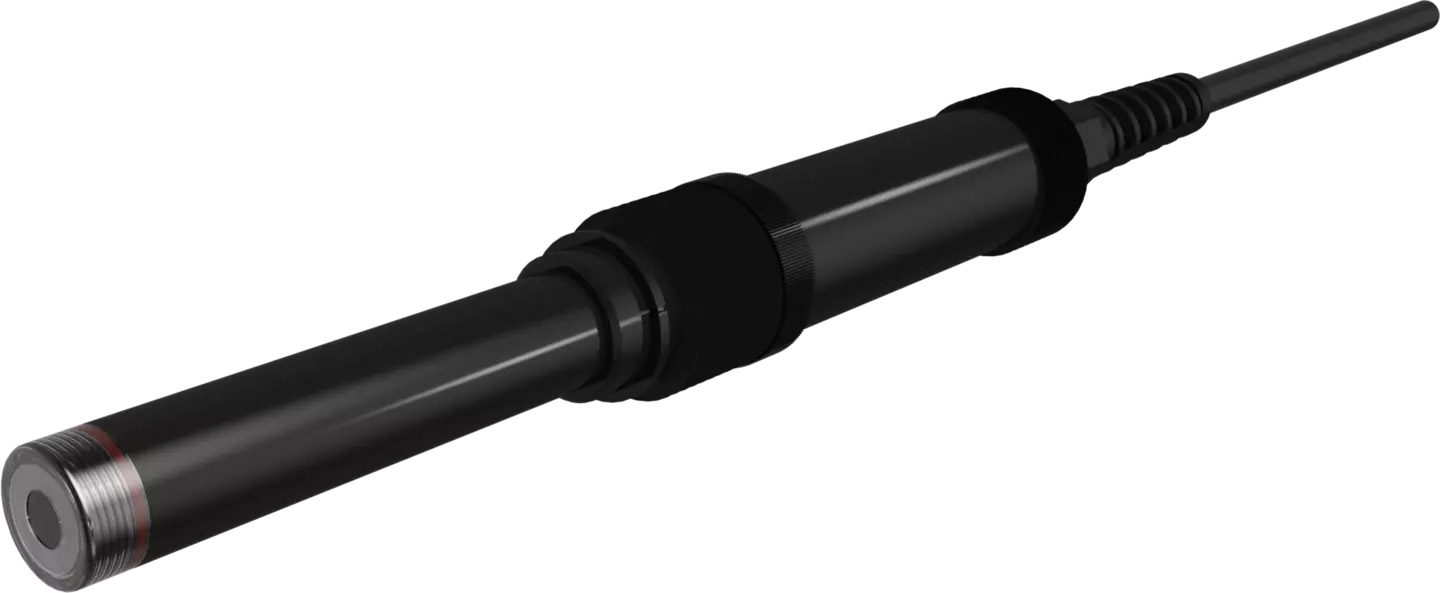
JUMO digiLine O-DO S10 – Intelligent oxygen sensor for dissolved oxygen (DO)


€1,181.00*
Please log in to receive your conditions.
Available in 28 days, delivery time 1-2 days
(Login for quotation) The entered number of pieces will be taken into account when creating the quotation.
Product information "JUMO digiLine O-DO S10 – Intelligent oxygen sensor for dissolved oxygen (DO)"
Optical dissolved oxygen sensor from JUMO for precise measurement of dissolved oxygen in water and process media
JUMO digiLine O-DO S10 – Intelligent Sensor for Dissolved Oxygen
The JUMO digiLine O-DO S10 is an optical dissolved oxygen sensor designed for reliable monitoring of dissolved oxygen in water and process media. It combines low-maintenance operation with digital and analog communication for stable process and water quality control.
The sensor from JUMO is an intelligent sensor that operates according to the optical luminescence quenching principle, providing stable and low-drift measurement values for demanding water analysis applications.
Thanks to the optical measuring method, traditional maintenance tasks such as electrolyte replacement or polarization phases are eliminated, significantly simplifying operation and increasing availability during ongoing processes. At the same time, the robust design ensures reliable use in both freshwater and saltwater applications.
The measured values are automatically temperature compensated and can additionally be corrected for environmental conditions such as air pressure or salinity. This ensures particularly high measurement accuracy under changing process conditions.
For integration into existing systems, the sensor offers both digital communication via RS-485 Modbus RTU and an analog 4–20 mA two-wire signal. Configuration and calibration data are stored directly in the sensor and can be retrieved when required, providing a traceable calibration history.
An integrated logbook documents the most recent calibrations, while a self-diagnostic function continuously monitors operating status and provides notifications in the event of deviations. The sensor cap is replaceable, further simplifying maintenance.
Advantages
- optical measurement without electrolyte consumption
- no polarization required
- low-maintenance sensor solution with long calibration intervals
- stable and low-drift measurement values
- automatic temperature compensation
- digital and analog signal transmission available
- integrated self-diagnostics and calibration history
- easy sensor cap replacement in case of wear
Technical Data
- Product: JUMO digiLine O-DO S10
- Measured parameter: dissolved oxygen (DO)
- Measuring principle: optical (luminescence quenching according to ASTM D888-05)
- Output: RS485 Modbus RTU / 4–20 mA two-wire
- Communication: digital and analog
- Cable: permanently attached, 5-pin M12 connector
- Housing material: PVC
- Temperature compensation: automatic
- Additional functions: calibration memory, logbook, self-diagnostics
- Connection: Rp 1 or optional G 1 thread with mounting kit
- Cable length: 10 m
Typical Applications
- drinking and service water monitoring
- wastewater treatment plants and wastewater technology
- aquaculture and fish farming
- process water monitoring
- environmental and water analysis
| Pos. | Feature | Code | Description |
|---|---|---|---|
| (1) | Basic type | 202614 |
JUMO digiLine O-DO S10 |
| (2) | Basic type extension | 10 |
Standard version |
| (3) | Measuring range | 37 |
0 to 20 ppm (mg/l)a |
| (4) | Electrical connection | 21 |
Fixed cable with M12 connector |
| (5) | Fixed cable length | 10 |
10 m |
30 |
30 m | ||
| (6) | Type additions | 000 |
None |
| a Factory setting = 0 to 200 % saturation. To output 0 to 20 ppm (mg/l), this setting must be changed in the sensor configuration. | |||
| Component | (1) | (2) | (3) | (4) | (5) | (6) |
|---|---|---|---|---|---|---|
| Ordering key | 202614 | 10 | 37 | 21 | 10 | 000 |
| Separator | / | - | - | - | / | – |
| Ordering example |
202614/10-37-21-10/000
|
|||||
Frequently Asked Questions
To display and measure dissolved oxygen in water or liquids.
It uses state-of-the-art optical technology to provide stable, long-term reliable readings. The measurement is based on the optical principle of luminescence quenching in accordance with ASTM D888-05.
Yes, via a digital RS485 interface or as an analogue 4–20 mA signal.
No. The sensor provides the readings, which are displayed, for example, on a meter or PC.
Yes, it has a robust PVC housing and is suitable for fresh and salt water.
It indicates water quality, e.g. in fish farming, sewage treatment plants or industrial processes.
Dimensions
| Height | 10 cm |
|---|---|
| Length | 36 cm |
| Width | 12 cm |
Weight
| Weight | 900 g |
|---|
Other attributes
| Country of origin | DE |
|---|---|
| Customs tariff number | 90278990 |
Technical specifications:
|
measurement principle |
Optical measurement based on the principle of luminescence (quenching) |
|
measuring parameters |
Dissolved oxygen Temperature |
|
Measuring ranges Dissolved oxygena temperature |
0.00 to 20.00 ppm (mg/l) 0.00 to 250.00 % Sat. 0.00 to 52.00 % Vol. 0.00 to 514.00 hPa pO b 2 -5 to +50 °Ccd |
|
Accuracy (at 25 °C) Basic tolerance plus |
1 % Sat. (≙ 0.1 mg/l or 0.2% vol. or 2 hPa pO2) ≤ 1 % of measured value from 0 % Sat. ≤ 2 % of measured value from 100 % Sat. ≤ 3 % of measured value from 200 % Sat. |
|
Response time (at 25 °C) |
t90 < 60 s |
|
pressure range |
0 to 5 bar |
|
ambient temperature |
0 to +50 °C |
|
storage temperature |
-10 to +60° C |
|
temperature compensation |
Via integrated temperature sensor in the range from -10 to +60 °C |
|
air pressure compensation |
10 to 2000 hPa |
|
salinity compensation |
0,00 to 60,00 mS/cme |
|
sampling interval |
3 s |
|
degree of protection |
IP68 |
|
Luminophore service life |
Up to 3 years (depending on process conditions) |
a The sensor is not suitable for measuring trace concentrations. The specifications apply to the following ambient conditions: temperature = 25 °C, air pressure = 1013 hPa, and salinity = 0 mS/cm.
b pO2 = oxygen partial pressure. The measured values in this measuring range are calculated from the raw data. All other measured values are calculated by the sensor depending on temperature, pressure, and salinity. The pO2 unit is primarily suitable for measurements in gases; in liquid analysis, it can only be used for special measurements.
c The oxygen measurement can be calibrated in a temperature range from +5 to 40 °C.
d The temperature sensor built into the sensor is suitable for measuring temperature, but not for controlling a process temperature.
e The input value is the temperature-compensated electrolytic conductivity, reference temperature = 25 °C.
RS485 interface
|
protocol |
JUMO digiLinea Modbus RTUb |
|
device address |
1 to 247 |
|
Data formats |
8 - 1 - no parity 8 - 2 - no parity 8 - 1 - odd parity 8 - 1 - even parity |
|
baud rates |
9600 Baud 19200 Baud 38400 Baud |
|
Minimum response time |
Adjustable from 0 to 500 ms |
a The JUMO digiLine protocol automatically assigns the interface parameters during commissioning (plug & play).
b The Modbus RTU protocol is used to operate the sensor on a JUMO mTRON T CPU or an AQUIS 500 RS transmitter/controller. When operating on a JUMO mTRON T, the interface parameters must be set with the JUMO DSM software before initial commissioning. The JUMO AQUIS 500 RS automatically detects the sensor and sets the appropriate interface parameters.
c Specification in the format of useful bits - stop bit - parity.