
HORIBA Electrodes & Sensors – Precise Measurement Technology for Reliable Analyses
High-quality sensor technology for accurate measurement of various water parameters
In this category, you will find electrodes and sensors from HORIBA for the precise determination of various water and process parameters. The components are specifically designed for reliable use in different applications and enable accurate and stable measurement results.
Reliable measurement values for demanding applications with Horiba sensor technology
The electrodes and sensors measure important parameters such as pH value, redox, conductivity, or dissolved oxygen. They form the basis for precise analysis and a reliable evaluation of water and process conditions.
Thanks to their robust design and high measurement accuracy, the sensors are suitable for continuous applications as well as for demanding operating conditions.
Why are high-quality sensors crucial?
-
Direct basis of measurement
The electrode is the central element of every measurement. Its quality determines the accuracy of the results. -
Stability and reliability
High-quality sensors provide consistent values. This is essential for safe process control. -
Adaptation to different applications
Depending on the medium and application, specific sensors are required. This ensures optimal measurement results.
Typical application areas
- Water treatment and process monitoring
- Industrial and plant control
- Laboratory and quality analyses
- Environmental analysis and water monitoring
Your added value in
- Reliable measurement technology for various parameters
- Robust designs for different applications
- Support for stable and accurate measurement results
Benefit from high-quality sensor technology and ensure the accuracy of your measurements in every application.

Calcium (Ca2+) ion-selective electrode for 300 seriesThe new electrode is suitable for the LAQUA WQ-300 series from Horiba and offers precise and reliable measurements for ions in aqueous solutions. It is characterised by its user-friendly handling and environmentally friendly design and can be used for a wide range of applications.Linearity in measurement range:The range where the calibration curve has linearity is called the measurement range. When lower concentration is measured where the linearity is not established, perform calibration at two points in the lower concentration range.Below graph shows the theoretical calibration curve of a calcium ion selective electrode.Influence of pH:The impact of the pH may cause a decrease in the slope of the ion selective electrode, or parallel shifting of the calibration curve. To prevent these effects, set the pH to an appropriate value in advance and keep it constant.Interfering ions:Ion selective electrodes have good selectivity with respect to the ions to be measured, but they may react to the other ions. When using the ion electrode method, it is important to know the effects of coexistent ions and take measures to avoid them. Interfering ions may form compounds with poor solubility or may form complex salts with the structure material of the ion selective membrane, these may to have a significant impact on the measured value.Conditioning:An electrode is conditioned by soaking it in a standard solution for 1 hour or longer. Use a standard solution whose concentration is 100 mg/L or more.In the following cases, perform conditioning of the electrode before calibration.• Before the first use.• Before use after storage for 2 weeks or longer.• If the electrode is less responsive.Calibration:Always calibrate with at least 2 calibration solutions which are 1 decade apart and bracket the expected measurement value.Use fresh calibration solutions and do not re-use them.• Below 10 ppm (mg/L)First solution between 1 and 10ppmSecond solution between 10 and 50 ppm• Between 10 and 100 ppm (mg/L)First solution between 10 and 100ppmSecond solution between 100 and 1000 ppm• Above 100 ppm (mg/L)First solution between 100 and 1000ppmFurther information can be found in the download area of the store. Manufacturer article number: 3200986786 (300-CA-C)

Potassium (K+) ion-selective electrode for 300 series The new electrode is suitable for the LAQUA WQ-300 series from Horiba and offers precise and reliable measurements for ions in aqueous solutions. It is characterised by its user-friendly handling and environmentally friendly design and can be used for a wide range of applications.Features:Measurement parameters: Potassium (K+) Solid-state electrodes that do not require refilling Double junction made of porous sintered polyethylene Integrated temperature sensor Environmentally friendly design made from bio-based plastic Supplied with calibration and ionic strength adjustment solutions Robust housing made of polycarbonate and PVC Low maintenance, simply rinse and seal Waterproof according to IP67Linearity in measurement range:The range where the calibration curve has linearity is called the measurement range. When lower concentration is measured where the linearity is not established, perform calibration at two points in the lower concentration range.Influence of pH:The impact of the pH may cause a decrease in the slope of the ion selective electrode, or parallel shifting of the calibration curve. To prevent these effects, set the pH to an appropriate value in advance and keep it constant.→Set the pH to an appropriate value in advance and keep it constant.If the pH of the sample solution exceeds 11, adjust the pH in the range of 5 to 11 by adding hydrochloric acid HCl.If the pH of the sample solution is less than 5, adjust the pH in the range of 5 to 11 by adding sodium hydroxide NaOH.Interfering ions:Ion selective electrodes have good selectivity with respect to the ions to be measured, but they may react to the other ions. When using the ion electrode method, it is important to know the effects of coexistent ions and take measures to avoid them. Interfering ions may form compounds with poor solubility or may form complex salts with the structure material of the ion selective membrane, these may to have a significant impact on the measured value. Conditioning:An electrode is conditioned by soaking it in a standard solution for 1 hour or longer. Use a standard solution whose concentration is 100 mg/L or more.In the following cases, perform conditioning of the electrode before calibration.• Before the first use.• Before use after storage for 2 weeks or longer.• If the electrode is less responsive.Calibration:Always calibrate with at least 2 calibration solutions which are 1 decade apart and bracket the expected measurement value.Use fresh calibration solutions and do not re-use them.• Below 10 ppm (mg/L)First solution between 1 and 10ppmSecond solution between 10 and 50 ppm• Between 10 and 100 ppm (mg/L)First solution between 10 and 100ppmSecond solution between 100 and 1000 ppm• Above 100 ppm (mg/L)First solution between 100 and 1000ppmSecond solution above 1000 ppmFurther information can be found in the data sheets in the download area of the store. Manufacturer article number: 3200986785 (300-K-C)

Sodium (Na+) ion-selective electrode for 300 seriesThe new electrode is suitable for the LAQUA WQ-300 series from Horiba and offers precise and reliable measurements for ions in aqueous solutions. It is characterized by its user-friendly handling and environmentally friendly design and is versatile in use. Features:Measurement parameters: Sodium (Na+)Solid-state electrodes that do not require refillingDouble junction made of porous sintered polyethyleneIntegrated temperature sensorEnvironmentally friendly design made from bio-based plasticDelivery includes calibration and ionic strength adjustment solutionsRobust housing made of polycarbonate and PVCLow maintenance, simply rinse and sealWaterproof according to IP67Linearity in measurement range:The range where the calibration curve has linearity is called the measurement range. When lower concentration is measured where the linearity is not established, perform calibration at two points in the lower concentration range.Influence of pH:The impact of the pH may cause a decrease in the slope of the ion selective electrode, or parallel shifting of the calibration curve. To prevent these effects, set the pH to an appropriate value in advance and keep it constant.→Set the pH to an appropriate value in advance and keep it constant.If the pH of the sample solution exceeds 10, adjust the pH in the range of 5 to 10 by adding hydrochloric acid HCl.If the pH of the sample solution is less than 5, adjust the pH in the range of 5 to 10 by adding sodium hydroxide NaOH.Interfering ions:Ion selective electrodes have good selectivity with respect to the ions to be measured, but they may react to the other ions. When using the ion electrode method, it is important to know the effects of coexistent ions and take measures to avoid them. Interfering ions may form compounds with poor solubility or may form complex salts with the structure material of the ion selective membrane, these may to have a significant impact on the measured value. Conditioning:An electrode is conditioned by soaking it in a standard solution for 1 hour or longer. Use a standard solution whose concentration is 100 mg/L or more.In the following cases, perform conditioning of the electrode before calibration.• Before the first use.• Before use after storage for 2 weeks or longer.• If the electrode is less responsive.Calibration:Always calibrate with at least 2 calibration solutions which are 1 decade apart and bracket the expected measurement value.Use fresh calibration solutions and do not re-use them.• Below 10 ppm (mg/L)First solution between 1 and 10ppmSecond solution between 10 and 50 ppm• Between 10 and 100 ppm (mg/L)First solution between 10 and 100ppmSecond solution between 100 and 1000 ppm• Above 100 ppm (mg/L)First solution between 100 and 1000ppmSecond solution above 1000 ppmFurther documentation can be found in the download area of our store Manufacturer article number: 3200986787 (300-NA-C)

Manufacturer's number: 3014081712For water with low conductivity (e.g. deionized, distilled)Glass housing, platinum/platinum black, k=1, conductivity measuring cell with integrated temperature sensor Waterproof

Manufacturer's number: 3014081714For water with high conductivity Glass body, platinum/platinum black, k=10, conductivity measuring cell with integrated temperature sensor Waterproof

Manufacturer number: 3014082592For column chromatography with a very small sample quantityGlass body, platinum/platinum black, k=10, conductivity measuring cell
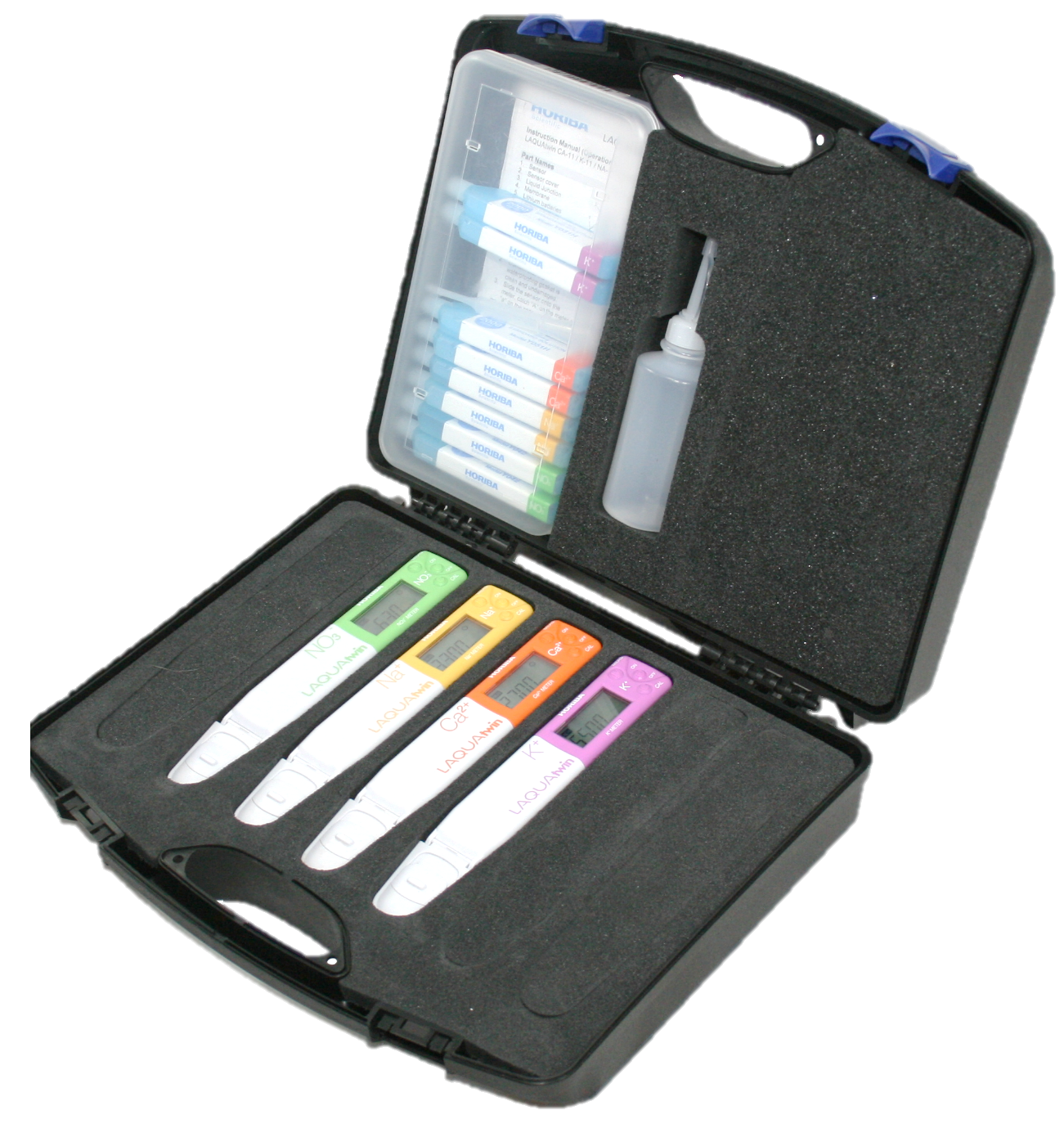
Mobile Analysis Laboratory for Ion Measurements – Versatile Use Compact kit for simultaneous determination of multiple water and environmental parameters The Horiba 4M LAQUAtwin Kit is a mobile laboratory that allows you to determine important ion parameters directly on-site. The case contains pocket testers for measuring sodium, potassium, nitrate, and calcium, as well as for temperature measurement. Each device uses ion-selective electrodes for targeted analysis of small samples and provides fast, reliable results. In addition to the four measurement devices, the kit includes calibration solutions and a wash/spray bottle for sensor cleaning. The sensors can be stored dry without special storage solutions. Compact Multi-Parameter Kit for Flexible On-Site Analyses The set is designed for measurement tasks where multiple ions need to be detected simultaneously, for example when monitoring drinking and process water, performing environmental checks of water bodies, conducting aquaculture analyses, or agricultural research. Thanks to the case, all essential testers including accessories are always on hand and ready for immediate use. The measurement results are available in a short time and are reliable and reproducible – ideal for routine and control measurements in the field. All components are neatly arranged in the case and ready for use at any time. An additional advantage is that the sensors can be stored dry without special storage solutions. Due to its compact design, the kit is particularly suitable for mobile applications where multiple ion parameters need to be determined quickly one after the other or in parallel. Why Multi-Parameter Ion Measurements Are Useful – and a Mobile Kit Is Ideal In many applications, not just a single measurement is important, but the interaction of multiple ion parameters. Sodium, potassium, nitrate, and calcium together influence water quality, biological processes, plant growth, and technical operations. Single measurements in a laboratory are often time-consuming and inflexible. A mobile analysis kit allows simultaneous detection of multiple parameters directly on-site. This allows relationships to be recognized more quickly, decisions to be made more reliably, and measurement campaigns to be carried out more efficiently. The Horiba 4M LAQUAtwin Kit combines these advantages in a compact, user-friendly system. Additional information We would like to inform you of an upcoming product update for the LAQUAtwin handheld analysers. To enhance product safety and prevent infants and young children from accidentally swallowing the batteries, HORIBA will be introducing a new battery cover on all LAQUAtwin pocket-sized analysers. Overview of the product change Change: Battery cover for enhanced safety. Reason: To prevent accidental swallowing of batteries. Production date: From January 2026 in Japan Deliveries to EMEA distribution partners: From March 2026 As this change is currently being rolled out, mixed deliveries of the current and updated versions may occur during the transition period. Frequently asked questions How long is the warranty period for HORIBA pocket testers? The warranty period is two years from delivery for commercial customers. How many measurements can be taken before the sensor needs to be replaced? This varies depending on the application, use and storage of the Horiba tester. As a rule, the sensor should be replaced after one year. How long is the warranty period for replacement sensors for pocket testers? The warranty period is 12 months after delivery for commercial customers. How do you clean the pocket tester? The pocket tester can be rinsed under water. We recommend cleaning with DI water (deionised). Tissue paper is recommended for drying after cleaning. How can the pocket tester be reset to factory settings? (e.g. in the event of an incorrect measurement result) This information can be found in the operating instructions. These can be found in the download area of the shop and on the product. Is calibration necessary before each measurement? Basically, yes. Further information can be found in the operating instructions.

Manufacturer's number.: 3200698386Ion selective electrodes respond to the concentration of specific ions in the test liquid and are variable potential electrodes. They are used in combination with reference electrodes to measure the concentration of certain ions.When measuring with an ion meter, the ion concentration can be read directly by calibrating with different standard solutions. Since the volume reading changes with temperature, the measurements must be taken at a fixed temperature.

Manufacturer number: 3014081107This refillable pH electrode can measure samples in very slender test tubes (e.g., NMR test tubes) due to its long, thin, glass-body.Waterproof

Manufacturer number: 3014080850This glass electrode with conical tip and integrated temperature sensor is designed for pH measurement in food.

Manufacturer number: 3014079136This glass-body, refillable pH electrode with temperature sensor has a sleeve junction for improved stability and repeatability. Ideal for highly accurate pH measurement.

Manufacturer's number: 3200697407 Ion-selective electrodes respond to the concentration of specific ions in the test fluid and are variable potential electrodes. They are used in combination with reference electrodes to measure the concentration of certain ions. When measuring with an ion meter, the ion concentration can be read directly by calibrating with different standard solutions. Since the volume reading changes with temperature, measurements must be taken at a fixed temperature. Note: Chloride sensor, if selected, is supplied without chloride ion strength regulator and chloride electrode filling solution. This must be procured by the customer. Without the filling solution the sensor can´t be used.

Manufacturer's number: 3200693774 Ion-selective electrodes respond to the concentration of specific ions in the test fluid and are variable potential electrodes. They are used in combination with reference electrodes to measure the concentration of certain ions. When measuring with an ion meter, the ion concentration can be read directly by calibrating with different standard solutions. Since the volume reading changes with temperature, the measurements must be taken at a fixed temperature.

Manufacturer's number: 3200697408 Ion-selective electrodes respond to the concentration of specific ions in the test fluid and are variable potential electrodes. They are used in combination with reference electrodes to measure the concentration of certain ions. When measuring with an ion meter, the ion concentration can be read directly by calibrating with different standard solutions. Since the volume reading changes with temperature, the measurements must be taken at a fixed temperature.

Manufacturer's Number: 3200697409 Ion-selective electrodes respond to the concentration of specific ions in the test fluid and are variable potential electrodes. They are used in combination with reference electrodes to measure the concentration of certain ions. When measuring with an ion meter, the ion concentration can be read directly by calibrating with different standard solutions. Since the volume reading changes with temperature, measurements must be taken at a fixed temperature.

Manufacturer's number: 3200697410 Ion-selective electrodes respond to the concentration of specific ions in the test fluid and are variable potential electrodes. They are used in conjunction with reference electrodes to measure the concentration of certain ions. When measuring with an ion meter, the ion concentration can be read directly by calibrating with different standard solutions. Since the volume reading changes with temperature, measurements must be taken at a fixed temperature.

Horiba 7544 DO Electrode TipReplacement DO Electrode Tip for 9521-10D Comes with detachable stirrer holderTo be used with 9521-10D Galvanic DO ElectrodeCompatible with stirrer setManufacturer article number: 3200891724

Manufacturer's number: 3200697411Chloride (Cl-) replacement electrode tip for 6560S-10C

Manufacturer's number: 3200693606Fluoride (Fl-) replacement electrode tip for 6561S-10C

Manufacturer's Number: 3200697412 Nitrate (NO3-) replacement electrode tip for 6581S-10C

Manufacturer's Number: 3200697413Potassium (K+) replacement electrode tip for 6582S-10C

Manufacturer's number: 3200697414Calcium (Ca2+) replacement electrode tip for 6583S-10C

Manufacturer number: 3014046710The flat platinum sensor at the tip allows measurement of samples with small volumeWaterproofCombined electrode

Manufacturer number: 3200922105The flat platinum sensor at the tip allows measurement of samples with small volumeWaterproofNot refillableCombined electrode