
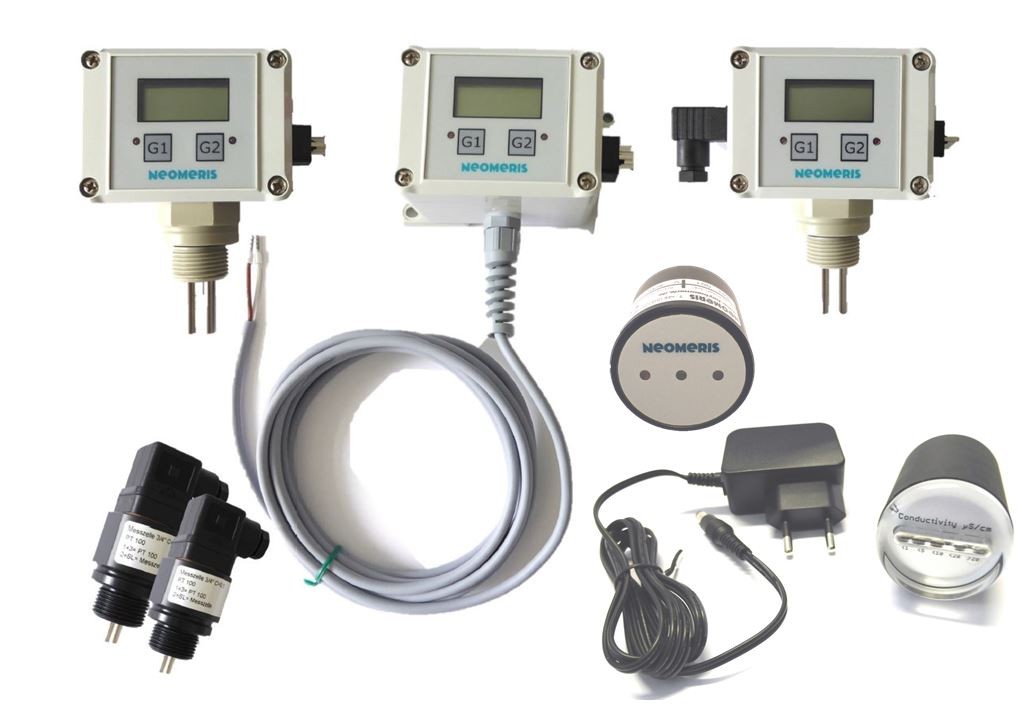
Conductivity Measuring Instruments

- 1 side connected to solenoid valve connector without seal ("Plug and Play", as plug only has to be plugged onto measuring cell)- 1 side labelled cable with wire end ferruleswhite: PT100brown: PT100yellow: Measuring cell SL green: Measuring cellblue: shielding

- 1 side connected to solenoid valve connector without seal ("Plug and Play", as plug only has to be plugged onto measuring cell)- 1 side labelled cable with wire end ferruleswhite: PT100brown: PT100yellow: Measuring cell SL green: Measuring cellblue: shielding

JUMO 25 Meter Connection Cable JUMO 25 meter connection cable - Ideal for sensors, measuring devices or controllers with 4-wire connection This JUMO connection cable with a length of 25 meters is designed for the electrical connection of suitable sensors or measuring components to the connected evaluation unit. Thanks to the 4-wire design with additional shielding, it is particularly suitable for applications where reliable signal transmission must be ensured even over longer distances. Technical data Length: 25 meters Version: Connection cable Number of wires: 4-wire Additional feature: Shielded Advantages and special features of the JUMO connection cable A major advantage of this cable is its generous length. This is especially practical when a greater distance must be bridged between the sensor and the evaluation unit and a shorter standard cable is not sufficient. The shielded design supports secure and interference-free signal transmission, which can be an important factor in industrial or technical applications. Why should you choose this connection cable? This version is particularly useful when a suitable cable is required for longer installation distances. The combination of 25 meters in length, 4 wires and shielding makes it a practical solution for measuring points where reliable connectivity and clean cable routing are important. Especially in permanently installed applications, this can be a clear advantage. Such a cable is also useful in daily operation when sensors cannot be mounted directly near the evaluation or control technology. It provides greater flexibility in planning the measuring point and can help securely connect suitable components even over longer distances. Frequently Asked Questions What equipment can I use it with? Ideal for sensors, measuring instruments or control units with a 4-wire connection. Is the cable shielded? Yes, the cable has a shield that reduces interference. Is the cable easy to install? Yes, the cable is flexible enough for use in conduits, cable ducts or for open-lay installation. Is the cable robust enough for workshop or industrial use? Yes, it withstands normal wear and tear in protected environments. Is the cable available in other lengths? We currently offer 25-metre and 50-metre versions. How can I correctly identify the individual wires when connecting them? Each of the four wires is colour-coded; the instructions will help you with the connection.

JUMO 50 Meter Connection Cable JUMO 50 meter connection cable - Ideal for sensors, measuring devices or controllers with 4-wire connection This JUMO connection cable with a length of 50 meters is designed for the electrical connection of suitable sensors or measuring components to the connected evaluation unit. Thanks to the 4-wire design with additional shielding, it is particularly suitable for applications where reliable signal transmission must be ensured even over longer distances. Technical data Length: 50 meters Version: Connection cable Number of wires: 4-wire Additional feature: Shielded Advantages and special features of the JUMO connection cable A major advantage of this cable is its length. This is especially practical when a greater distance must be bridged between the sensor and the evaluation unit and shorter standard cables are not sufficient. The shielded design supports interference-free signal transmission, which can be an important factor in industrial and technical applications. Why should you choose this JUMO connection cable? This version is particularly useful when a suitable cable is required for longer installation distances. The combination of 50 meters in length, 4 wires and shielding makes it a practical solution for measuring points where reliable connectivity and clean cable routing are important. Especially in permanently installed applications, this offers greater flexibility during planning. Areas of application Such a cable is also useful in daily operation when sensors cannot be mounted directly near the evaluation or control technology. It provides greater flexibility when positioning the components and helps securely connect suitable devices even over longer distances. Anyone looking for a shielded connection cable with a length of 50 meters for suitable JUMO sensors or measuring components receives a practical solution for long connection paths and reliable signal transmission with this version. Frequently Asked Questions What equipment can I use it with? Ideal for sensors, measuring instruments or control units with a 4-wire connection. Is the cable shielded? Yes, the cable has a shield that reduces interference. Is the cable easy to install? Yes, the cable is flexible enough for use in conduits, cable ducts or for open-lay installation. Is the cable robust enough for workshop or industrial use? Yes, it withstands normal wear and tear in protected environments. Is the cable available in other lengths? We currently offer 25-metre and 50-metre versions. How can I correctly identify the individual wires when connecting them? Each of the four wires is colour-coded; the instructions will help you with the connection.
2-electrode principleproven versions for industrial use measuring ranges 0 ... 1 mS/cm (K = 0.1) or 0.01 ... 15 mS/cm (K = 1.0) temperature range up to 55 °C, maximum pressure up to 6 bar at 25 °C JUMO ecoLine CR-PVC conductive 2-electrode conductivity sensorBrief description: Conductivity sensors of the 202923 series are used, for example, in general water technology, cooling and air-conditioning systems, drinking and bathing water, or in industrial rinsing and process water circuits. The body material PVC limits the application to medium temperatures up to 55 °C. Two versions with cell constants K = 0.1 or 1.0 are available. Versions with the common thread sizes G 3/4" or G 1" or a plug-in version are available for installation. The plug-in version is used, for example, with the matching PVC tees in nominal sizes DN 25, 32 and 40 and allows the sensor to be quickly dismantled for cleaning or maintenance. The electrical connection is made either via a detachable device plug or via a fixed cable connection. The overall construction and the parts in contact with the medium are physiologically harmless. The electrode material is stainless steel (K = 0.1) or special graphite (K = 1.0). The optionally integrable temperature sensor allows simultaneous recording of the medium temperature for temperature compensation in downstream measuring amplifiers.Stainless steel variant K = 0.1 The sensor has 3 metallic pin electrodes. The two outer pins are electrically connected and form one pole of the 2-electrode conductivity sensor. The counter electrode is the middle stainless steel pin. This design achieves very high measurement precision with low stray fields. A temperature sensor can be integrated in the middle pin. Graphite variant K = 1.0 For physical reasons, special graphite is used as the electrode material for higher conductance values. The two graphite electrodes are completely integrated in the electrode shaft. The optional temperature sensor is located in a stainless steel sleeve that is immersed in the measured medium. Operating principleThe sensors of the 202923 series are 2-electrode conductivity sensors. An AC voltage is applied to them by the transmitter. The current flowing across the liquid and the electrodes is determined by the conductivity of the liquid

Our Neomeris conductivity cell with 12mm connection is used for the determination of the electrical conductivity in aqueous solutions. Inside the T-piece is the two-electrode measuring cell without temperature compensation. The installation is easy and fast due to the John Guest connectors. We recommend the use of the product in the fields of distillate, condensate, ultrapure water as well as fully demineralized water. Technical data Material Housing: POM T-piece John Guest ½" Material electrodes: V4A 4571 Cell constant: C = 0.1 +-5% Max. operating pressure: 6 bar Max. operating temperature: 60°C Electrical connection: - brown electrode, outer sheath - white Electrode, inside - blue: shieldCable length: 2.5 meters

Capacity measurement ion exchanger cartridgeOur Neomeris N-FLASH10 conductivity meter in a T-piece with 3/8 inch connection is a conductivity measuring instrument that is used to monitor the electrical conductivity of water after flowing through the ion exchanger cartridge. The measuring instrument including the integrated measuring cell is battery operated and permanently installed in the T-piece. If the measured electrical conductivity is below the limit value of 10µS/cm, the green LED flashes; if it is above, the red LED flashes, indicating that a cartridge or resin change is required. Due to the T-piece used, the measuring device can also be integrated very easily and is optimally installed in the liquid flow for a stable measurement. Measuring principle: The measuring cell generates an electrical signal that is proportional to the conductivity of the liquid. This signal is processed in the device and the LED is controlled via the programming stored in the device. Application: Conductivity meters are often used in water treatment plants in the process industry.Technical data:Screw-in thread: 3/8"; others available upon requestMaterial housing: POM black Material lid: Plexiglas Material electrodes: V4A 4571 Material O-ring: EPDM Cell constant: C= 0.6 +/- 10% Max. Operating pressure: 6 bar Max. Operating temperature: 60°C Temperature sensor: without Display: LED green <10μS/cm LED red >10μS/cm

Technical data: Screw-in thread: 1/4"; 1/2"; 3/4"; others available upon requestMaterial housing: POM black Material lid: Plexiglas Material electrodes: V4A 4571 Material O-ring: EPDM Cell constant: C= 0.6 +/- 10% Max. Operating pressure: 6 bar Max. Operating temperature: 60°C Temperature sensor: without Display: LED green <10μS/cm LED red >10μS/cm

Technical data: Screw-in thread: 1/4"; 1/2"; 3/4"; others available upon requestMaterial housing: POM black Material lid: Plexiglas Material electrodes: V4A 4571 Material O-ring: EPDM Cell constant: C= 0.6 +/- 10% Max. Operating pressure: 6 bar Max. Operating temperature: 60°C Temperature sensor: without Display: LED green <10μS/cm LED red >10μS/cm

Technical data: Screw-in thread: 1/4"; 1/2"; 3/4"; others available upon requestMaterial housing: POM black Material lid: Plexiglas Material electrodes: V4A 4571 Material O-ring: EPDM Cell constant: C= 0.6 +/- 10% Max. Operating pressure: 6 bar Max. Operating temperature: 60°C Temperature sensor: without Display: LED green <10μS/cm LED red >10μS/cm

Technical data: Screw-in thread: 1/4"; 1/2"; 3/4"; others available upon requestMaterial housing: POM black Material lid: Plexiglas Material electrodes: V4A 4571 Material O-ring: EPDM Cell constant: C= 0.6 +/- 10% Max. Operating pressure: 6 bar Max. Operating temperature: 60°C Temperature sensor: without Display: LED green <10μS/cm LED red >10μS/cm

Technical data: Screw-in thread: 1/4"; 1/2"; 3/4"; others available upon requestMaterial housing: POM black Material lid: Plexiglas Material electrodes: V4A 4571 Material O-ring: EPDM Cell constant: C= 0.6 +/- 10% Max. Operating pressure: 6 bar Max. Operating temperature: 60°C Temperature sensor: without Display: LED green <10μS/cm LED red >10μS/cm

Technical data: Screw-in thread: 1/4"; 1/2"; 3/4"; others available upon requestMaterial housing: POM black Material lid: Plexiglas Material electrodes: V4A 4571 Material O-ring: EPDM Cell constant: C= 0.6 +/- 10% Max. Operating pressure: 6 bar Max. Operating temperature: 60°C Temperature sensor: without Display: LED green <10μS/cm LED red >10μS/cm

Technical data: Screw-in thread: 1/4"; 1/2"; 3/4"; others available upon requestMaterial housing: POM black Material lid: Plexiglas Material electrodes: V4A 4571 Material O-ring: EPDM Cell constant: C= 0.6 +/- 10% Max. Operating pressure: 6 bar Max. Operating temperature: 60°C Temperature sensor: without Display: LED green <10μS/cm LED red >10μS/cm

Technical data: Screw-in thread: 1/4"; 1/2"; 3/4"; others available upon requestMaterial housing: POM black Material lid: Plexiglas Material electrodes: V4A 4571 Material O-ring: EPDM Cell constant: C= 0.6 +/- 10% Max. Operating pressure: 6 bar Max. Operating temperature: 60°C Temperature sensor: without Display: LED green <10μS/cm LED red >10μS/cm

Technical data: Screw-in thread: 1/4"; 1/2"; 3/4"; others available upon requestMaterial housing: POM black Material lid: Plexiglas Material electrodes: V4A 4571 Material O-ring: EPDM Cell constant: C= 0.6 +/- 10% Max. Operating pressure: 6 bar Max. Operating temperature: 60°C Temperature sensor: without Display: LED green <20μS/cm LED yellow 20-50μS/cm LED red >50μS/cm Frequently Asked Questions Why do I need a conductivity meter in my system? It allows you to quickly see how clean your water is and whether, for example, a filter or water treatment system is working properly. For which systems is this meter particularly well suited? It is frequently used in water treatment and osmosis systems, or in technical installations for water monitoring. Can I simply screw the measuring cell into my water pipe? Yes, it is screwed directly into a 3/4″ connection and can usually be easily integrated. How accurately does the device indicate water quality? It measures the conductivity of the water and thus quickly indicates changes in water quality. Is the device also suitable for very pure water? Yes, the measuring range up to 100 µS is specifically designed for very pure or treated water. Do I need to maintain or clean the measuring device regularly? As a rule, occasional inspection and cleaning of the measuring cell is sufficient.

Technical data: Screw-in thread: 1/4"; 1/2"; 3/4"; others available upon requestMaterial housing: POM black Material lid: Plexiglas Material electrodes: V4A 4571 Material O-ring: EPDM Cell constant: C= 0.6 +/- 10% Max. Operating pressure: 6 bar Max. Operating temperature: 60°C Temperature sensor: without Display: LED green <20μS/cm LED yellow 20-50μS/cm LED red >50μS/cm Frequently Asked Questions Why do I need a conductivity meter in my system? It allows you to quickly see how clean your water is and whether, for example, a filter or water treatment system is working properly. For which systems is this meter particularly well suited? It is frequently used in water treatment and osmosis systems, or in technical installations for water monitoring. Can I simply screw the measuring cell into my water pipe? Yes, it is screwed directly into a 3/4″ connection and can usually be easily integrated. How accurately does the device indicate water quality? It measures the conductivity of the water and thus quickly indicates changes in water quality. Is the device also suitable for very pure water? Yes, the measuring range up to 100 µS is specifically designed for very pure or treated water. Do I need to maintain or clean the measuring device regularly? As a rule, occasional inspection and cleaning of the measuring cell is sufficient.

Features of the N-FLASH50 Device The N-FLASH50 is a compact, battery-powered conductivity meter designed to monitor conductivities in the range of 0 to 50 µS/cm. Thanks to its handy design, it is ideal for mobile use and short-term measurements directly on site. The clear LED display allows quick evaluation of measurement results without additional analysis devices. Mobile Conductivity Meter for Quick Checks Three integrated LEDs clearly indicate the current measurement status: green signals a safe range, yellow indicates threshold levels, and red warns of excessively high conductivity. The integrated 3/4"-threaded measurement cell allows direct installation in pipelines and ensures uncomplicated measurement during ongoing operations. Battery operation provides maximum flexibility, independent of external power supply. Why Conductivity Is Measured in Water Treatment Conductivity indicates how many dissolved salts and ions are present in water. It is therefore an important indicator for assessing water quality. In water treatment, it is used to monitor desalination and treatment processes and to detect deviations from target values early. Excessively high conductivity values can indicate exhausted filters, defective membranes, or contamination. Regular measurement protects equipment, ensures process quality, and helps comply with regulatory limits. Frequently asked questions Are there other measuring ranges available? The standard measuring ranges can be found in the product's drop-down menu. If the measuring range you require is not listed, don't worry. Simply let us know and we will check whether we can configure the item to suit your needs. Are there other thread sizes available? If the desired connection thread is not listed, that's no problem. Let us know your desired thread and we will check whether we can configure the item for you with the appropriate thread. For enquiries, please contact our service department on +49 (0) 5121 7609 99 or at vertrieb@heylneomeris.de Is it possible to label the conductivity meter with my own company logo so that we can sell it ourselves in future? That's no problem. Please provide us with more detailed information so that we can process your enquiry. Please note that the price will change due to the increased effort involved and that the minimum purchase quantity for product labelling is 100 units.

Technical data: Screw-in thread: 1/4"; 1/2"; 3/4"; others available upon requestMaterial housing: POM black Material lid: Plexiglas Material electrodes: V4A 4571 Material O-ring: EPDM Cell constant: C= 0.6 +/- 10% Max. Operating pressure: 6 bar Max. Operating temperature: 60°C Temperature sensor: without Display: LED green <20μS/cm LED yellow 20-50μS/cm LED red >50μS/cm Frequently Asked Questions Why do I need a conductivity meter in my system? It allows you to quickly see how clean your water is and whether, for example, a filter or water treatment system is working properly. For which systems is this meter particularly well suited? It is frequently used in water treatment and osmosis systems, or in technical installations for water monitoring. Can I simply screw the measuring cell into my water pipe? Yes, it is screwed directly into a 3/4″ connection and can usually be easily integrated. How accurately does the device indicate water quality? It measures the conductivity of the water and thus quickly indicates changes in water quality. Is the device also suitable for very pure water? Yes, the measuring range up to 100 µS is specifically designed for very pure or treated water. Do I need to maintain or clean the measuring device regularly? As a rule, occasional inspection and cleaning of the measuring cell is sufficient.

Technical data: Screw-in thread: 1/4"; 1/2"; 3/4"; others available upon requestMaterial housing: POM black Material lid: Plexiglas Material electrodes: V4A 4571 Material O-ring: EPDM Cell constant: C= 0.6 +/- 10% Max. Operating pressure: 6 bar Max. Operating temperature: 60°C Temperature sensor: without Display: LED green <20μS/cm LED yellow 20-50μS/cm LED red >50μS/cm Frequently Asked Questions Why do I need a conductivity meter in my system? It allows you to quickly see how clean your water is and whether, for example, a filter or water treatment system is working properly. For which systems is this meter particularly well suited? It is frequently used in water treatment and osmosis systems, or in technical installations for water monitoring. Can I simply screw the measuring cell into my water pipe? Yes, it is screwed directly into a 3/4″ connection and can usually be easily integrated. How accurately does the device indicate water quality? It measures the conductivity of the water and thus quickly indicates changes in water quality. Is the device also suitable for very pure water? Yes, the measuring range up to 100 µS is specifically designed for very pure or treated water. Do I need to maintain or clean the measuring device regularly? As a rule, occasional inspection and cleaning of the measuring cell is sufficient.

Technical data: Screw-in thread: 1/4"; 1/2"; 3/4"; others available upon requestMaterial housing: POM black Material lid: Plexiglas Material electrodes: V4A 4571 Material O-ring: EPDM Cell constant: C= 0.6 +/- 10% Max. Operating pressure: 6 bar Max. Operating temperature: 60°C Temperature sensor: without Display: LED green <20μS/cm LED yellow 20-50μS/cm LED red >50μS/cm Frequently Asked Questions Why do I need a conductivity meter in my system? It allows you to quickly see how clean your water is and whether, for example, a filter or water treatment system is working properly. For which systems is this meter particularly well suited? It is frequently used in water treatment and osmosis systems, or in technical installations for water monitoring. Can I simply screw the measuring cell into my water pipe? Yes, it is screwed directly into a 3/4″ connection and can usually be easily integrated. How accurately does the device indicate water quality? It measures the conductivity of the water and thus quickly indicates changes in water quality. Is the device also suitable for very pure water? Yes, the measuring range up to 100 µS is specifically designed for very pure or treated water. Do I need to maintain or clean the measuring device regularly? As a rule, occasional inspection and cleaning of the measuring cell is sufficient.

Technical data: Screw-in thread: 1/4"; 1/2"; 3/4"; others available upon requestMaterial housing: POM black Material lid: Plexiglas Material electrodes: V4A 4571 Material O-ring: EPDM Cell constant: C= 0.6 +/- 10% Max. Operating pressure: 6 bar Max. Operating temperature: 60°C Temperature sensor: without Display: LED green <20μS/cm LED yellow 20-50μS/cm LED red >50μS/cm Frequently Asked Questions Why do I need a conductivity meter in my system? It allows you to quickly see how clean your water is and whether, for example, a filter or water treatment system is working properly. For which systems is this meter particularly well suited? It is frequently used in water treatment and osmosis systems, or in technical installations for water monitoring. Can I simply screw the measuring cell into my water pipe? Yes, it is screwed directly into a 3/4″ connection and can usually be easily integrated. How accurately does the device indicate water quality? It measures the conductivity of the water and thus quickly indicates changes in water quality. Is the device also suitable for very pure water? Yes, the measuring range up to 100 µS is specifically designed for very pure or treated water. Do I need to maintain or clean the measuring device regularly? As a rule, occasional inspection and cleaning of the measuring cell is sufficient.

Technical data: Screw-in thread: 1/4"; 1/2"; 3/4"; others available upon requestMaterial housing: POM black Material lid: Plexiglas Material electrodes: V4A 4571 Material O-ring: EPDM Cell constant: C= 0.6 +/- 10% Max. Operating pressure: 6 bar Max. Operating temperature: 60°C Temperature sensor: without Display: LED green <20μS/cm LED yellow 20-50μS/cm LED red >50μS/cm Frequently Asked Questions Why do I need a conductivity meter in my system? It allows you to quickly see how clean your water is and whether, for example, a filter or water treatment system is working properly. For which systems is this meter particularly well suited? It is frequently used in water treatment and osmosis systems, or in technical installations for water monitoring. Can I simply screw the measuring cell into my water pipe? Yes, it is screwed directly into a 3/4″ connection and can usually be easily integrated. How accurately does the device indicate water quality? It measures the conductivity of the water and thus quickly indicates changes in water quality. Is the device also suitable for very pure water? Yes, the measuring range up to 100 µS is specifically designed for very pure or treated water. Do I need to maintain or clean the measuring device regularly? As a rule, occasional inspection and cleaning of the measuring cell is sufficient.

Technical data: Measuring range: 0 - 10 μS/cm (without temperature compensation) <0.1 <0.5 < 1.0 < 5.0 < 10 μS/cm LED display: 3x green; 1x yellow; 1x red Power supply: 100-240 VAC plug-in power supply unit Energy consumption: < 500 mWHousing material: POM black (polyoxymethylene) Viewing window material: PMMA (acrylic glass) Electrodes: Stainless steel 1.4571 Dimensions: Diameter 40 mm x 68 mm (Top) / 110 mm (Total) Gasket electrodes: EPDM Gasket housing: EPDM Application limits: Pressure max.: 6 bar; Temperature max.: 60 °C Protection class: IP 65* Display Measuring range 3 LED green < 0.1 μS/cm 2 LED green < 0.5 μS/cm 1 LED green < 1.0 μS/cm 1 LED yellow < 5 μS/cm 1 LED red < 10 μS/cm 1 LED red flashing ≥ 10 μS/cm