Electrodes and sensors are used in industry for a variety of applications to measure and monitor physical, chemical and biological processes.
The electrodes and sensors are generally used to measure and control certain parameters. They are used to increase efficiency and improve the quality of production processes and to ensure safety in the workplace.
Overall, electrodes and sensors help to make industrial processes more efficient, safer and of higher quality. They enable the measurement and control of important parameters in order to increase the effectiveness and profitability of production processes.
Some examples of applications are
- pH sensors and electrodes
- Oxygen sensors and electrodes
- Conductivity sensors and electrodes
- Temperature sensors and electrodes
- Biological sensors and electrodes
- Water Analyzers
- Liquid chemistry
- Controls
- Electrodes and sensors
- Hand-held measuring instruments and analysis cases
- Laboratory Benchtop Meters
- NeoTec World
- Permeate
- Clinical Solutions
- Seminars & Webinars
- Ozone and UV technology
- Dosing pumps
- Gas Measuring Instruments
- Hygiene and Disinfection
- Water Meters
- Accessories
- Blog
Filter products
JUMO eTRON T100 - electronic thermostat with timer function for mounting on 35 mm top-hat rails Typ: 701052/8-01-02-01/000 Version: Standard with factory settings Input: resistance thermometer Pt100, Pt1000, KTY2X-6 Power supply: AC 230 V +10/-15%, 48 to 63 Hz Option: Digital output PhotoMOS ® relay (connection of resistance thermometers in three-wire circuit is not possible) Extra code: without Available in 5 different measuring groups Intuitive operation and configuration both directly on the device and via the setup programme using the USB interface User area with 8 adjustable parameters Data logger functionality for recording measurement data Dot matrix display with 64 x 80 pixels and support for 4 national languages Service and operating hours counter for monitoring device utilisation Connection via PCB terminals with push-in technology for easy installation Use of 10A relays (changeover contacts) for reliable switching Option for customer-specific linearisation of the measurement results in the setup program Limit value monitoring for precise control and monitoring of processes Timer function for time-controlled execution of actions The digital thermostat measures the temperature using resistance thermometers, thermocouples or a current of 0(4) to 20 mA and can be configured as a simple heating or cooling thermostat depending on the selected mode. The thermostat function (heating or cooling) can be started or limited in time using the timer function. The switching states of the relay and digital output, as well as the actual and setpoint values, are shown simultaneously on a backlit display with a resolution of 64 x 80 pixels. The display language can be switched between German, English, French and Spanish. It is operated via four buttons on the front, while the electrical connection is made via print terminals with push-in technology. PhotoMOS® relays for limit value monitoring or a digital input for connecting a potential-free contact can be added as an option. A setup programme is available for easy configuration.
JUMO eTRON T100 - electronic thermostat with timer function for mounting on 35 mm top-hat rails Typ: 701052/8-01-02-00/000 Version: Standard with factory settings Input: resistance thermometer Pt100, Pt1000, KTY2X-6 Power supply: AC 230 V +10/-15%, 48 to 63 Hz Option: none Extra code: without Available in 5 different measuring groups Intuitive operation and configuration both directly on the device and via the setup programme using the USB interface User area with 8 adjustable parameters Data logger functionality for recording measurement data Dot matrix display with 64 x 80 pixels and support for 4 national languages Service and operating hours counter for monitoring device utilisation Connection via PCB terminals with push-in technology for easy installation Use of 10A relays (changeover contacts) for reliable switching Option for customer-specific linearisation of the measurement results in the setup program Limit value monitoring for precise control and monitoring of processes Timer function for time-controlled execution of actions The digital thermostat measures the temperature using resistance thermometers, thermocouples or a current of 0(4) to 20 mA and can be configured as a simple heating or cooling thermostat depending on the selected mode. The thermostat function (heating or cooling) can be started or limited in time using the timer function. The switching states of the relay and digital output, as well as the actual and setpoint values, are shown simultaneously on a backlit display with a resolution of 64 x 80 pixels. The display language can be switched between German, English, French and Spanish. It is operated via four buttons on the front, while the electrical connection is made via print terminals with push-in technology. PhotoMOS® relays for limit value monitoring or a digital input for connecting a potential-free contact can be added as an option. A setup programme is available for easy configuration.
JUMO eTRON T100 - electronic thermostat with timer function for mounting on 35 mm top-hat rails Typ: 701052/8-01-31-00/000 Version: Standard with factory settings Input: resistance thermometer Pt100, Pt1000, KTY2X-6 Power supply: DC 12 to 24 V +15/-15 % / AC 230 V +10/-15%, 48 to 63 Hz Option: none Extra code: without Available in 5 different measuring groups Intuitive operation and configuration both directly on the device and via the setup programme using the USB interface User area with 8 adjustable parameters Data logger functionality for recording measurement data Dot matrix display with 64 x 80 pixels and support for 4 national languages Service and operating hours counter for monitoring device utilisation Connection via PCB terminals with push-in technology for easy installation Use of 10A relays (changeover contacts) for reliable switching Option for customer-specific linearisation of the measurement results in the setup program Limit value monitoring for precise control and monitoring of processes Timer function for time-controlled execution of actions The digital thermostat measures the temperature using resistance thermometers, thermocouples or a current of 0(4) to 20 mA and can be configured as a simple heating or cooling thermostat depending on the selected mode. The thermostat function (heating or cooling) can be started or limited in time using the timer function. The switching states of the relay and digital output, as well as the actual and setpoint values, are shown simultaneously on a backlit display with a resolution of 64 x 80 pixels. The display language can be switched between German, English, French and Spanish. It is operated via four buttons on the front, while the electrical connection is made via print terminals with push-in technology. PhotoMOS® relays for limit value monitoring or a digital input for connecting a potential-free contact can be added as an option. A setup programme is available for easy configuration.
JUMO eTRON T100 - electronic thermostat with timer function for mounting on 35 mm top-hat rails Typ: 701052/8-02-02-00/000 Version: Standard with factory settings Input: Thermocouple Power supply: AC 230 V +10/-15%, 48 to 63 Hz Option: Digital output PhotoMOS ® relay (connection of resistance thermometers in three-wire circuit is not possible) Extra code: without Available in 5 different measuring groups Intuitive operation and configuration both directly on the device and via the setup programme using the USB interface User area with 8 adjustable parameters Data logger functionality for recording measurement data Dot matrix display with 64 x 80 pixels and support for 4 national languages Service and operating hours counter for monitoring device utilisation Connection via PCB terminals with push-in technology for easy installation Use of 10A relays (changeover contacts) for reliable switching Option for customer-specific linearisation of the measurement results in the setup program Limit value monitoring for precise control and monitoring of processes Timer function for time-controlled execution of actions The digital thermostat measures the temperature using resistance thermometers, thermocouples or a current of 0(4) to 20 mA and can be configured as a simple heating or cooling thermostat depending on the selected mode. The thermostat function (heating or cooling) can be started or limited in time using the timer function. The switching states of the relay and digital output, as well as the actual and setpoint values, are shown simultaneously on a backlit display with a resolution of 64 x 80 pixels. The display language can be switched between German, English, French and Spanish. It is operated via four buttons on the front, while the electrical connection is made via print terminals with push-in technology. PhotoMOS® relays for limit value monitoring or a digital input for connecting a potential-free contact can be added as an option. A setup programme is available for easy configuration.
JUMO eTRON T100 - electronic thermostat with timer function for mounting on 35 mm top-hat rails Typ: 701052/8-02-31-00/000 Version: Standard with factory settings Input: Thermocouple Power supply: DC 12 to 24 V +15/-15% / AC 230 V +10/-15%, 48 to 63 Hz Option: Digital output PhotoMOS ® relay (connection of resistance thermometers in three-wire circuit is not possible) Extra code: without Available in 5 different measuring groups Intuitive operation and configuration both directly on the device and via the setup programme using the USB interface User area with 8 adjustable parameters Data logger functionality for recording measurement data Dot matrix display with 64 x 80 pixels and support for 4 national languages Service and operating hours counter for monitoring device utilisation Connection via PCB terminals with push-in technology for easy installation Use of 10A relays (changeover contacts) for reliable switching Option for customer-specific linearisation of the measurement results in the setup program Limit value monitoring for precise control and monitoring of processes Timer function for time-controlled execution of actions The digital thermostat measures the temperature using resistance thermometers, thermocouples or a current of 0(4) to 20 mA and can be configured as a simple heating or cooling thermostat depending on the selected mode. The thermostat function (heating or cooling) can be started or limited in time using the timer function. The switching states of the relay and digital output, as well as the actual and setpoint values, are shown simultaneously on a backlit display with a resolution of 64 x 80 pixels. The display language can be switched between German, English, French and Spanish. It is operated via four buttons on the front, while the electrical connection is made via print terminals with push-in technology. PhotoMOS® relays for limit value monitoring or a digital input for connecting a potential-free contact can be added as an option. A setup programme is available for easy configuration.
JUMO eTRON T100 - electronic thermostat with timer function for mounting on 35 mm top-hat rails Typ: 701052/8-03-02-00/000 Version: Standard with factory settings Input: 0(4) bis 20mA Power supply: AC 230 V +10/-15%, 48 to 63 Hz Option: without Extra code: without Available in 5 different measuring groups Intuitive operation and configuration both directly on the device and via the setup programme using the USB interface User area with 8 adjustable parameters Data logger functionality for recording measurement data Dot matrix display with 64 x 80 pixels and support for 4 national languages Service and operating hours counter for monitoring device utilisation Connection via PCB terminals with push-in technology for easy installation Use of 10A relays (changeover contacts) for reliable switching Option for customer-specific linearisation of the measurement results in the setup program Limit value monitoring for precise control and monitoring of processes Timer function for time-controlled execution of actions The digital thermostat measures the temperature using resistance thermometers, thermocouples or a current of 0(4) to 20 mA and can be configured as a simple heating or cooling thermostat depending on the selected mode. The thermostat function (heating or cooling) can be started or limited in time using the timer function. The switching states of the relay and digital output, as well as the actual and setpoint values, are shown simultaneously on a backlit display with a resolution of 64 x 80 pixels. The display language can be switched between German, English, French and Spanish. It is operated via four buttons on the front, while the electrical connection is made via print terminals with push-in technology. PhotoMOS® relays for limit value monitoring or a digital input for connecting a potential-free contact can be added as an option. A setup programme is available for easy configuration.
Ultrasonic flow meters Ultrasonic flow meters work largely independently of the specific properties of the product to be measured, such as pressure, temperature, viscosity or conductivity. Due to these advantages, they can be used in a wide range of applications. A further advantage of these systems is that they have no mechanical parts and are therefore less susceptible to maintenance than other flow meters. Principle of ultrasonic measurement: The basis of ultrasonic-based flow measurement is a system consisting of two sensors that communicate directly with each other. In accordance with DIN standard 1319, the flow measuring device consists of two parts: the actual measuring sensor in the form of the ultrasonic sensor and the measuring transducer or transmitter as the evaluation unit. For the measurement, an ultrasonic pulse (sound waves) is sent between the two sensors through the medium to be measured in a pipe. The transit times in the direction of flow and against the direction of flow are measured continuously. It measures the difference in the transit time of these pulses in the direction of flow and against the direction of flow. Without water flow, the signal propagation times in the flow direction and vice versa are identical. If water flows through the measuring section, the propagation speed of the sound waves is accelerated in the direction of flow and delayed in the opposite direction. The transit time difference between the two ultrasonic waves of a data pair is directly proportional to the average flow velocity. To determine the flow volume in relation to a defined period of time (second, minute, hour), the average flow velocity is multiplied by the respective pipe cross-section of the sensor used. The so-called transit time difference method is a proven and widely used measurement method in industrial environments for recording flow volumes. As a result, the meter displays the exact water consumption, regardless of whether the flow rate is high, low, constant or variable. When using ultrasonic flow meters, which work on the basis of the transit time difference method, it is important to ensure that the medium to be measured is as homogeneous as possible and only contains a very small amount of solids or gas.
JUMO hydro TRANS S20 - Humidity and temperature transmitter with optional wall-mounted CO2 module Typ: 907042/11-0-15-009/000 Basic type extension: RH-T Version: Standard Measuring range: 0 ... 100 % rH / -40 ... +80°C Output: 4 ... 20 mA / 0 ... 10 V combi output config. Extra code: without Measuring parameters: Temperature, relative humidity, carbon dioxide (CO2) optional Interfaces: USB, RS485, Sigle Pair Ethernet (SPE) Robustness Easy to install Multi-sensor Optional plastic sintered filter The humidity and temperature transducer monitors the quality of the ambient air and can be wall-mounted both indoors and in protected outdoor areas. Areas of application Climate monitoring Ventilation systems Building management Storage rooms
JUMO hydro TRANS S20 - Humidity and temperature transmitter with optional wall-mounted CO2 module Typ: 907042/11-0-15-009/994 Basic type extension: RH-T Version: Standard Measuring range: 0 ... 100 % rH / -40 ... +80°C Output: 4 ... 20 mA / 0 ... 10 V combi output config. Extra code: with integrated display Robustness Easy to install Multi-sensor Optional plastic sintered filter The humidity and temperature transducer monitors the quality of the ambient air and can be wall-mounted both indoors and in protected outdoor areas. Areas of application Climate monitoring Ventilation systems Building management Storage rooms
JUMO hydro TRANS S20 - Humidity and temperature transmitter with optional wall-mounted CO2 module Typ: 907042/11-0-15-530/000 Basic type extension: RH-T Version: Standard Measuring range: 0 ... 100 % rH / -40 ... +80°C Output: RS-485 Modbus Extra code: without Measuring parameters: Temperature, relative humidity, carbon dioxide (CO2) optional Interfaces: USB, RS485, Sigle Pair Ethernet (SPE) Robustness Easy to install Multi-sensor Optional plastic sintered filter The humidity and temperature transducer monitors the quality of the ambient air and can be wall-mounted both indoors and in protected outdoor areas. Areas of application Climate monitoring Ventilation systems Building management Storage rooms
JUMO hydro TRANS S20 - Humidity and temperature transmitter with optional wall-mounted CO2 module Typ: 907042/12-0-17-535/994 Basic type extension: RH-T-CO2 Version: Standard Measuring range: 0 ... 95 % rH / -10 ... +60°C / 10.000 ppm Output: SPE with PoDL (modbus TCP slave) Extra code: Integrated display Measuring parameters: Temperature, relative humidity, carbon dioxide (CO2) optional Interfaces: USB, RS485, Sigle Pair Ethernet (SPE) Robustness Easy to install Multi-sensor Optional plastic sintered filter The humidity and temperature transducer monitors the quality of the ambient air and can be wall-mounted both indoors and in protected outdoor areas. Areas of application Climate monitoring Ventilation systems Building management Storage rooms
JUMO hydro TRANS S20 - Humidity and temperature transmitter with optional wall-mounted CO2 module Typ: 907042/11-0-15-530/994 Basic type extension: RH-T Version: Standard Measuring range: 0 ... 100 % rH / -40 ... +80°C Output: RS-485 Modbus Extra code: Integrated display Measuring parameters: Temperature, relative humidity, carbon dioxide (CO2) optional Interfaces: USB, RS485, Sigle Pair Ethernet (SPE) Robustness Easy to install Multi-sensor Optional plastic sintered filter The humidity and temperature transducer monitors the quality of the ambient air and can be wall-mounted both indoors and in protected outdoor areas. Areas of application Climate monitoring Ventilation systems Building management Storage rooms
JUMO hydro TRANS S20 - Humidity and temperature transmitter with optional wall-mounted CO2 module Typ: 907042/12-0-17-009/000 Basic type extension: RH-T-CO2 Version: Standard Measuring range: 0 ... 95 % rH / -10 ... +60°C / 10.000 ppm Output: 4 bis 20 mA / 0 bis 10 V combi output configurable Extra code: without Measuring parameters: Temperature, relative humidity, carbon dioxide (CO2) optional Interfaces: USB, RS485, Sigle Pair Ethernet (SPE) Robustness Easy to install Multi-sensor Optional plastic sintered filter The humidity and temperature transducer monitors the quality of the ambient air and can be wall-mounted both indoors and in protected outdoor areas. Areas of application Climate monitoring Ventilation systems Building management Storage rooms
JUMO hydro TRANS S20 - Humidity and temperature transmitter with optional wall-mounted CO2 module Typ: 907042/12-0-17-009/994 Basic type extension: RH-T-CO2 Version: Standard Measuring range: 0 ... 95 % rH / -10 ... +60°C / 10.000 ppm Output: 4 ... 20 mA / 0 ... 10 V combi output config. Extra code: Integrated display Measuring parameters: Temperature, relative humidity, carbon dioxide (CO2) optional Interfaces: USB, RS485, Sigle Pair Ethernet (SPE) Robustness Easy to install Multi-sensor Optional plastic sintered filter The humidity and temperature transducer monitors the quality of the ambient air and can be wall-mounted both indoors and in protected outdoor areas. Areas of application Climate monitoring Ventilation systems Building management Storage rooms
JUMO hydro TRANS S20 - Humidity and temperature transmitter with optional wall-mounted CO2 module Typ: 907042/12-0-17-530/000 Basic type extension: RH-T-CO2 Version: Standard Measuring range: 0 ... 95 % rH / -10 ... +60°C / 10.000 ppm Output: RS-485 Modbus Extra code: without Measuring parameters: Temperature, relative humidity, carbon dioxide (CO2) optional Interfaces: USB, RS485, Sigle Pair Ethernet (SPE) Robustness Easy to install Multi-sensor Optional plastic sintered filter The humidity and temperature transducer monitors the quality of the ambient air and can be wall-mounted both indoors and in protected outdoor areas. Areas of application Climate monitoring Ventilation systems Building management Storage rooms
JUMO hydro TRANS S20 - Humidity and temperature transmitter with optional wall-mounted CO2 module Typ: 907042/12-0-17-530/994 Basic type extension: RH-T-CO2 Version: Standard Measuring range: 0 ... 95 % rH / -10 ... +60°C / 10.000 ppm Output: RS-485 Modbus Extra code: Integrated display Measuring parameters: Temperature, relative humidity, carbon dioxide (CO2) optional Interfaces: USB, RS485, Sigle Pair Ethernet (SPE) Robustness Easy to install Multi-sensor Optional plastic sintered filter The humidity and temperature transducer monitors the quality of the ambient air and can be wall-mounted both indoors and in protected outdoor areas. Areas of application Climate monitoring Ventilation systems Building management Storage rooms
JUMO hydro TRANS S30 - Humidity and temperature transmitter with optional CO2 module in duct version Typ: 907043/11 Basic type extension: RH-T Version: StandardMeasuring range: 0 to 100 % RH/-40 to +80 °COutput: 4 to 20 mA/0 to 10 V combined output configuredExtra code: Without Measuring parametersTemperatureRelative humidityCarbon dioxide (CO2) optional InterfacesUSB PORTRS485 Areas of applicationClimate monitoringVentilation systemsBuilding managementStorage roomsRailroad applications according to DIN EN 50155 Special featuresRobustnessEasy to installMultisensorOptional plastic sintered filter The humidity and temperature transducer monitors the outside air flowing into buildings and production processes. It is suitable for installation in weather-protected ventilation ducts.
JUMO hydro TRANS S30 - Humidity and temperature transmitter with optional CO2 module in duct versionTyp: 907043/11 Basic type extension: RH-T Version: StandardMeasuring range: 0 to 100 % RH/-40 to +80 °COutput: RS485 ModbusExtra code: Without Measuring parametersTemperatureRelative humidityInterfacesRS485 Areas of applicationClimate monitoringVentilation systemsBuilding managementStorage roomsRailroad applications according to DIN EN 50155 Special featuresRobustnessEasy to installMultisensorOptional plastic sintered filter The humidity and temperature transducer monitors the outside air flowing into buildings and production processes. It is suitable for installation in weather-protected ventilation ducts.
JUMO hydro TRANS S30 - Humidity and temperature transmitter with optional CO2 module in duct version Typ: 907043/12 Basic type extension: RH-T Version: StandardMeasuring range: 0 to 95 % RH/-10 to +60 °COutput: 4 to 20 mA/0 to 10 V combined output configuredExtra code: Without Measuring parametersTemperatureRelative humidityCarbon dioxide (CO2) optional InterfacesUSB PORTRS485 Areas of applicationClimate monitoringVentilation systemsBuilding managementStorage roomsRailroad applications according to DIN EN 50155 Special featuresRobustnessEasy to installMultisensorOptional plastic sintered filter The humidity and temperature transducer monitors the outside air flowing into buildings and production processes. It is suitable for installation in weather-protected ventilation ducts.
JUMO hydro TRANS S30 - Humidity and temperature transmitter with optional CO2 module in duct versionTyp: 907043/12 Basic type extension: RH-T-CO2Version: StandardMeasuring range: 0 to 95 % RH/-10 to +60 °COutput: RS-485 ModbusExtra code: Without Measuring parametersTemperatureRelative humidityCarbon dioxide (CO2) optional InterfacesUSB PORTRS485 Areas of applicationClimate monitoringVentilation systemsBuilding managementStorage roomsRailroad applications according to DIN EN 50155 Special featuresRobustnessEasy to installMultisensorOptional plastic sintered filter The humidity and temperature transducer monitors the outside air flowing into buildings and production processes. It is suitable for installation in weather-protected ventilation ducts.
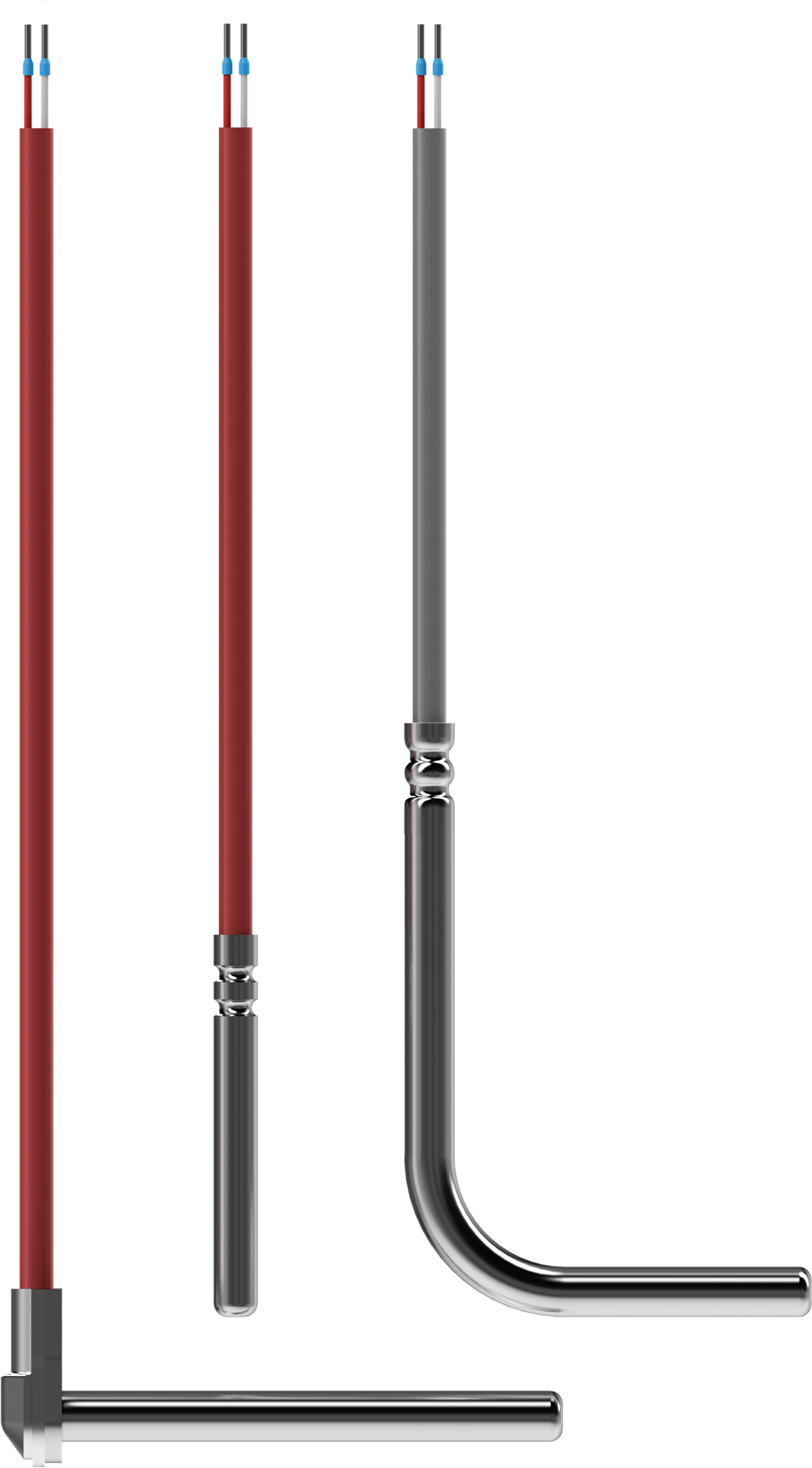
Push-in resistance thermometer in water vapour-tight designType: 902830/10-370-1011-2-6-100-11-2500/317 Measuring range -50 to +150°C Connection cable: PTFE 1x Pt 100 in four-wire circuit Single resistance thermometer Tolerance class A according to DIN EN 60 751 Thermowell diameter: 6 mm Insertion length: 100 mm Connection cable end: Wire end ferrules to DIN 46 228 Connection cable length: 2500 mm (standard) Extra codes: Shielded connecting cableThe plug-in resistance thermometer in water vapour-tight design is preferably used for temperature measurements in sterilisers. Their specific design allows them to be used in atmospheres containing water vapour and under pressure. Another area of application is in apparatus engineering and laboratory technology. The thermometer can be supplied with a PTFE connection cable, which enables operation in humid rooms in the temperature range from -50 to +150 °C, or alternatively an FEP connection cable is available, which covers temperatures from -70 to +200 °C.The transition of the connection cable is strain-relieved to ensure the longevity of the connection. The measuring insert is equipped as standard with a Pt 100 temperature insert in accordance with DIN EN 60 751, class A in a two-wire circuit. In addition, the connection can optionally be made in three- and four-wire circuits to meet individual requirements.