Electrodes and sensors are used in industry for a variety of applications to measure and monitor physical, chemical and biological processes.
The electrodes and sensors are generally used to measure and control certain parameters. They are used to increase efficiency and improve the quality of production processes and to ensure safety in the workplace.
Overall, electrodes and sensors help to make industrial processes more efficient, safer and of higher quality. They enable the measurement and control of important parameters in order to increase the effectiveness and profitability of production processes.
Some examples of applications are
- pH sensors and electrodes
- Oxygen sensors and electrodes
- Conductivity sensors and electrodes
- Temperature sensors and electrodes
- Biological sensors and electrodes
- Water Analyzers
- Liquid chemistry
- Controls
- Electrodes and sensors
- Hand-held measuring instruments and analysis cases
- Laboratory Benchtop Meters
- NeoTec World
- Permeate
- Clinical Solutions
- Seminars & Webinars
- Ozone and UV technology
- Dosing pumps
- Gas Measuring Instruments
- Hygiene and Disinfection
- Water Meters
- Accessories
- Blog
Filter products
Push-in resistance thermometer in water vapour-tight designType: 902830/10-370-2001-2-6-100-11-2500/000 Measuring range -50 to +150°C Connection cable: PTFE 2x Pt 100 in Three-wire circuit Single resistance thermometer Tolerance class A according to DIN EN 60 751 Thermowell diameter: 6 mm Insertion length: 100 mm Connection cable end: Wire end ferrules to DIN 46 228 Connection cable length: 2500 mm (standard) Extra codes: Shielded connecting cableThe plug-in resistance thermometer in water vapour-tight design is preferably used for temperature measurements in sterilisers. Their specific design allows them to be used in atmospheres containing water vapour and under pressure. Another area of application is in apparatus engineering and laboratory technology. The thermometer can be supplied with a PTFE connection cable, which enables operation in humid rooms in the temperature range from -50 to +150 °C, or alternatively an FEP connection cable is available, which covers temperatures from -70 to +200 °C.The transition of the connection cable is strain-relieved to ensure the longevity of the connection. The measuring insert is equipped as standard with a Pt 100 temperature insert in accordance with DIN EN 60 751, class A in a two-wire circuit. In addition, the connection can optionally be made in three- and four-wire circuits to meet individual requirements.
Push-in resistance thermometer in water vapour-tight design, pressure-tight up to 5.0 barType: 902830/30-302-1011-2-4-50-11-2500/000 Measuring range -70 to +200°C Connection cable: FEP 1 x Pt 100 in four-wire circuit Single resistance thermometer Tolerance class A according to DIN EN 60 751 Thermowell diameter: 4 mm Insertion length: 50 mm Connection cable end: Wire end ferrules to DIN 46 228 Connection cable length: 2500 mm (standard) Extra codes: without extra codeThe insertion resistance thermometer in water vapour-tight design is preferably used for temperature measurements in sterilisers. Their specific design allows them to be used in atmospheres containing water vapour and under pressure. Another area of application is in apparatus engineering and laboratory technology. The thermometer can be supplied with a PTFE connection cable, which enables operation in humid rooms in the temperature range from -50 to +150 °C, or alternatively an FEP connection cable is available, which covers temperatures from -70 to +200 °C.The transition of the connection cable is strain-relieved to ensure the longevity of the connection. The measuring insert is equipped as standard with a Pt 100 temperature insert in accordance with DIN EN 60 751, class A in a two-wire circuit. In addition, the connection can optionally be made in three- and four-wire circuits to meet individual requirements.
Push-in resistance thermometer in water vapour-tight design, pressure-tight up to 5.0 barType: 902830/30-302-2011-2-4,5-50-11-2500/000 Measuring range -70 to +200°C Connection cable: FEP 2 x Pt 100 in four-wire circuit Single resistance thermometer Tolerance class A according to DIN EN 60 751 Thermowell diameter: 4.5mm with 2 measuring circuits in four-wire circuit Installation length: 50 mm Connection cable end: Wire end ferrules according to DIN 46 228 Connection cable length: 2500 mm (standard) Extra codes: without extra codeThe plug-in resistance thermometer in water vapour-tight design is preferably used for temperature measurements in sterilisers. The specific design makes it suitable for use in atmospheres containing water vapour and under pressure. Another area of application is in apparatus engineering and laboratory technology. The thermometer can be supplied with a PTFE connection cable, which enables operation in humid rooms in the temperature range from -50 to +150 °C, or alternatively an FEP connection cable is available, which covers temperatures from -70 to +200 °C.The transition of the connection cable is strain-relieved to ensure the longevity of the connection. The measuring insert is equipped as standard with a Pt 100 temperature insert in accordance with DIN EN 60 751, class A in a two-wire circuit. In addition, the connection can optionally be made in three- and four-wire circuits to meet individual requirements.
Type: 902150/40-397-1003-1-6-60-11-2500/317 Temperature measuring range: -50 ... +350 °C / Metal mesh Measuring insert: 1x Pt 100 in two-wire circuit Installation length: 60 mm Cable length: 2500 mm Tolerance class: Class B (standard) Thermowell diameter: 6 mm Wire end ferrules Extra code: Shielded connecting cable Available as single and dual resistance thermometers Available in straight and angled versions to meet different installation requirements. Flexible connection cables Strain relief to protect against mechanical stress Meets SIL and PL qualification standards for maximum safety Optional kink protection Areas of application: Laboratory technology Climate cabinets Solar systems Heating, air conditioning, ventilation Apparatus engineering The insertion resistance thermometer offers precise temperature measurement in both liquid and gaseous media. The wide range of variants makes it ideal for various applications in industrial environments.This thermometer ensures reliable performance in dry and damp rooms and enables accurate temperature measurements. The robust design and flexible configuration options ensure precise temperature monitoring.
Push-in resistance thermometer with spiralised connection cable, one-piece stainless steel protection tube Type: 902150/30-388-1003-1-6-100-11-2500/315,317 Temperature measuring range: -50 ... +260 °C / metal braiding Measuring insert: 1x Pt 100 in two-wire circuit Installation length: 100 mm Cable length: 2500 mm Tolerance class: Class B (standard) Thermowell diameter: 6 mm Wire end ferrules Extra code: with bend protection, cable shielded Available as single and double resistance thermometers Available in straight and angled versions to meet different installation requirements. Flexible connection cables Strain relief to protect against mechanical stress Meets SIL and PL qualification standards for maximum safety Optional kink protection Areas of application: Areas of application: Laboratory technology Climate cabinets Solar systems Heating, air conditioning, ventilation Apparatus engineering The insertion resistance thermometer offers precise temperature measurement in both liquid and gaseous media. The wide range of variants makes it ideal for various applications in industrial environments. This thermometer ensures reliable performance in dry and damp rooms and enables accurate temperature measurements. The robust design and flexible configuration options ensure precise temperature monitoring.
Push-in resistance thermometer with spiralised connection cable, one-piece stainless steel protection tube Type: 902150/30-388-1001-1-6-100-11-2500/315,317 Temperature measuring range: -50 ... +260 °C / metal mesh Measuring insert: 1x Pt 100 in three-wire circuit Installation length: 100 mm Cable length: 2500 mm Tolerance class: Class B (standard) Thermowell diameter: 6 mm Wire end ferrules Extra code: with bend protection, cable shielded Available as single and double resistance thermometers Available in straight and angled versions to meet different installation requirements. Flexible connection cables Strain relief to protect against mechanical stress Meets SIL and PL qualification standards for maximum safety Optional kink protection Areas of application: Areas of application: Laboratory technology Climate cabinets Solar systems Heating, air conditioning, ventilation Apparatus engineering The insertion resistance thermometer offers precise temperature measurement in both liquid and gaseous media. The wide range of variants makes it ideal for various applications in industrial environments. This thermometer ensures reliable performance in dry and damp rooms and enables accurate temperature measurements. The robust design and flexible configuration options ensure precise temperature monitoring.
Push-in resistance thermometer with spiralised connection cable, one-piece stainless steel protection tube Type: 902150/30-402-1001-1-6-150-11-2500/315,317 Temperature measuring range: -50 ... +400 °C / Metal mesh Measuring insert: 1x Pt 100 in three-wire circuit Installation length: 150 mm Cable length: 2500 mm Tolerance class: Class B (standard) Thermowell diameter: 6 mm Wire end ferrules Extra code: with bend protection, cable shielded Available as single and double resistance thermometers Available in straight and angled versions to meet different installation requirements. Flexible connection cables Strain relief to protect against mechanical stress Meets SIL and PL qualification standards for maximum safety Optional kink protection Areas of application: Areas of application: Laboratory technology Climate cabinets Solar systems Heating, air conditioning, ventilation Apparatus engineering The insertion resistance thermometer offers precise temperature measurement in both liquid and gaseous media. The wide range of variants makes it ideal for various applications in industrial environments. This thermometer ensures reliable performance in dry and damp rooms and enables accurate temperature measurements. The robust design and flexible configuration options ensure precise temperature monitoring.
Push-in resistance thermometer with spiralised connection cable, one-piece stainless steel protection tube Type: 902150/20-730-1003-1-6-50-11-1100/000 Temperature measuring range: -5 ... +105 °C Measuring insert: 1x Pt 100 in two-wire circuit Installation length: 50 mm Cable length: 1100 mm (stretched) Tolerance class: Class B (standard) Thermowell diameter: 6 mm Wire end ferrules Extra code: without Available as single and dual resistance thermometers Available in straight and angled versions to meet different mounting requirements. Flexible connection cables Strain relief to protect against mechanical stress Meets SIL and PL qualification standards for maximum safety Optional kink protection Areas of application: Laboratory technology Climate cabinets Solar systems Heating, air conditioning, ventilation Apparatus engineering The insertion resistance thermometer offers precise temperature measurement in both liquid and gaseous media. The wide range of variants makes it ideal for various applications in industrial environments. This thermometer ensures reliable performance in dry and damp rooms and enables accurate temperature measurements. The robust design and flexible configuration options ensure precise temperature monitoring.
Ultrasonic flow meters Ultrasonic flow meters work largely independently of the specific properties of the product to be measured, such as pressure, temperature, viscosity or conductivity. Due to these advantages, they can be used in a wide range of applications. A further advantage of these systems is that they have no mechanical parts and are therefore less susceptible to maintenance than other flow meters. Principle of ultrasonic measurement: The basis of ultrasonic-based flow measurement is a system consisting of two sensors that communicate directly with each other. In accordance with DIN standard 1319, the flow measuring device consists of two parts: the actual measuring sensor in the form of the ultrasonic sensor and the measuring transducer or transmitter as the evaluation unit. For the measurement, an ultrasonic pulse (sound waves) is sent between the two sensors through the medium to be measured in a pipe. The transit times in the direction of flow and against the direction of flow are measured continuously. It measures the difference in the transit time of these pulses in the direction of flow and against the direction of flow. Without water flow, the signal propagation times in the flow direction and vice versa are identical. If water flows through the measuring section, the propagation speed of the sound waves is accelerated in the direction of flow and delayed in the opposite direction. The transit time difference between the two ultrasonic waves of a data pair is directly proportional to the average flow velocity. To determine the flow volume in relation to a defined period of time (second, minute, hour), the average flow velocity is multiplied by the respective pipe cross-section of the sensor used. The so-called transit time difference method is a proven and widely used measurement method in industrial environments for recording flow volumes. As a result, the meter displays the exact water consumption, regardless of whether the flow rate is high, low, constant or variable. When using ultrasonic flow meters, which work on the basis of the transit time difference method, it is important to ensure that the medium to be measured is as homogeneous as possible and only contains a very small amount of solids or gas.
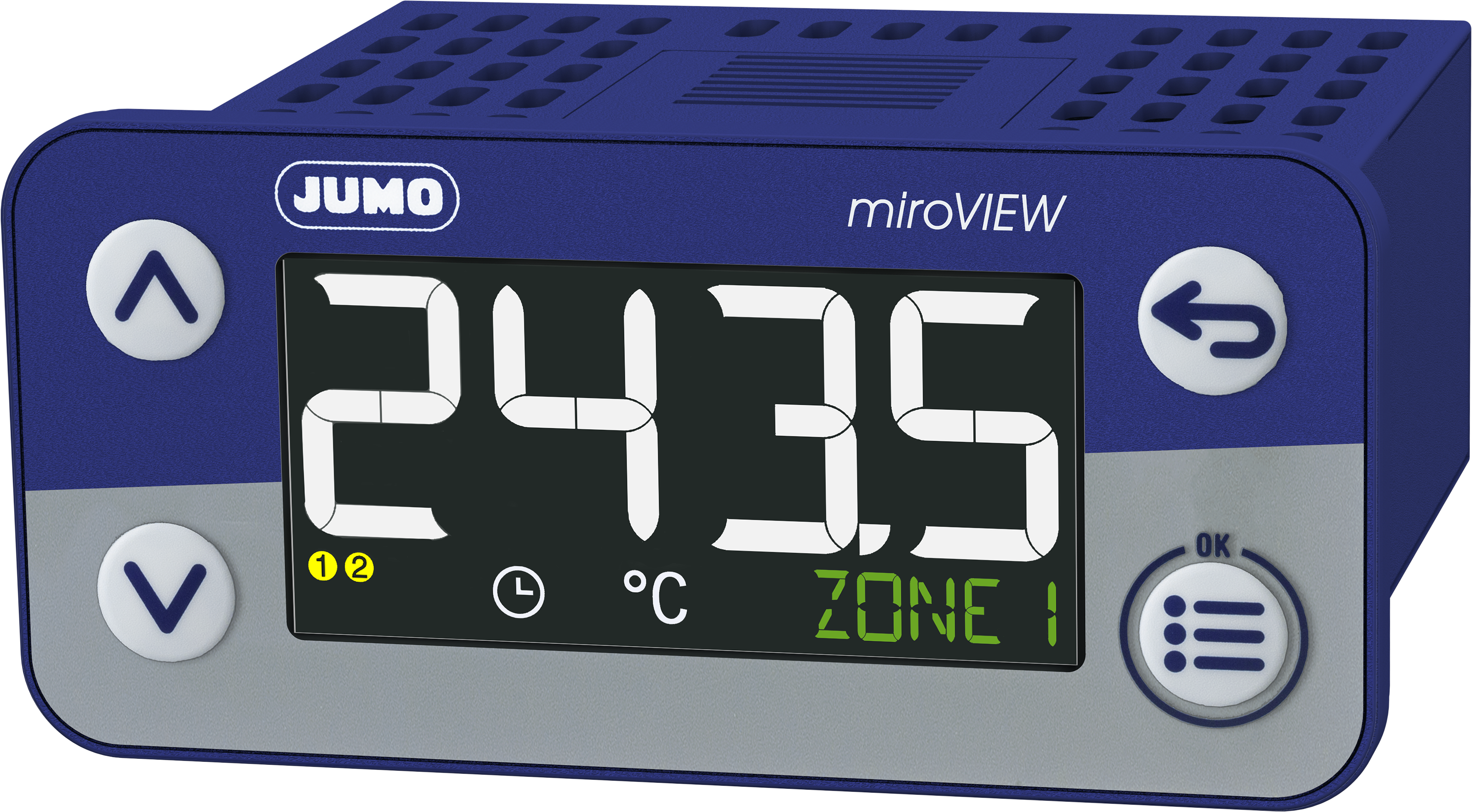
JUMO meroVIEW - Multifunction digital indicator with PLC function Typ: 701553/8-00-00-00-00-00-00-23/000 Version: Standard with factory settings Power supply: AC 10 to 240 V +10/-15% / 48 to 63 Hz Extra code: without Option1-6: not assigned 1 analogue input 1 digital input 1 digital input/output switchable 1 relay (NO contact) 2 timers Min/max display Hold function Tare function The display series comprises four universally applicable devices in various DIN formats, which are used to display temperature, pressure and other process variables.The devices offer user-friendly operation with a clearly structured layout and text support. Process values and parameters are displayed on two 18-segment LCD displays. Types 701552, 701553 and 701554 also have a pixel matrix LCD display for displaying texts. Additional display elements provide information about the switching positions of the outputs and certain functions such as timers. The devices are operated via a membrane keypad with 4 buttons and can also be used in demanding environments thanks to their high IP65 protection rating.The basic equipment already includes a min/max value display, hold function, temperature function, limit value monitoring, digital control signals, extensive timer functions and a service counter. Optionally, the devices can be extended with a maths and logic function as well as with ST code functionality to realise customer-specific functions. The ST code functionality also allows direct access to the display and operating buttons, which enables customised device operation. Inputs and outputsEach device type is equipped with a universal analogue input that is suitable for resistance thermometers, thermocouples, current, voltage, resistance transmitters and resistance/potentiometers. Each device also has a digital input, a switchable digital input/output and two relay outputs (NO contact 3 A). The digital inputs are intended for the connection of a potential-free contact, while the digital output supplies a logic signal of 0/14 V.The optional digital outputs with 0/14 V (not galvanically isolated) can be used, for example, to control solid-state relays. Alternatively, the optional digital outputs with 0/22 V and galvanic isolation can also be used as a voltage supply for two-wire transmitters.Please note that certain inputs and outputs cannot be used simultaneously (see notes in the wiring diagram). Customer-specific linearisationIndividual linearisation according to customer requirements also makes it possible to use sensor signals with special characteristics. Programming is carried out in the setup program either using your value table with up to 40 value pairs or using a formula (4th order polynomial). The device supports 2 customer-specific linearisations. Counting inputsThe device can optionally be equipped with up to 4 counting inputs, with a maximum counting frequency of 12.5 kHz. Each counting input can be controlled either with a digital signal of 0/24 V or via a potential-free contact. The counters allow the following functions to be configured: Counting of pulses Calculation of frequency speed Speed (volume per time unit) Flow rate (volume per time unit) In addition, individual functions can be implemented via maths functions or ST code, such as the calculation of the total flow rate (volume) Signal assignment via selectorsThe input signals and all internal signals are available in so-called selectors (analogue selector, digital selector) for further use in the device. The control signals for the outputs are also assigned via selectors, which enables flexible assignment of signals and functions. USB interfacesThe device has a USB device interface (Micro-B socket on the rear), which is intended exclusively for connection to a PC for use with the setup programme. There is also a USB host interface (type A socket), which is located on the rear of the 108 and 104 format devices and on the side of the smaller 116 format device. This interface is intended for connecting a USB memory stick in order to carry out firmware updates, read out data loggers and transfer the device configuration. RS485 interfaceThe RS485 interface is available as an option and supports the Modbus RTU protocol. It can be used in both master and slave mode. Ethernet interfaceThe Ethernet interface (Modbus TCP) is optional and enables parallel communication with 2x mater or 2x slave. It is used for integration into a company network, the transfer of process values and communication with the setup programme. PROFINET interfaceThe device can optionally be equipped with a PROFINET interface in order to be integrated into a PROFINET network as an IO device. A GSD file (GSDML) is available for the programming system of the IO controller, which describes the properties of the device. It should be noted that the standard Ethernet services are not supported via the PROFINET interface. If the device is equipped with the PROFINET interface, neither the Ethernet nor the RS485 interface can be used. Power supplyThe device is available in two power supply variants: AC 110 to 240 V or AC/DC 24 V (see Technical data). Electrical connectionThe electrical connection is time-saving with removable spring-loaded terminals (PushIn technology). Min-max functionWhen the min-max function is activated, both the minimum and maximum values of the indicator are saved and continuously updated. These values can be displayed separately or alternating with the current value. In the alternating display (scrolling), the min/max symbol is active while either the minimum or maximum value is displayed. A binary signal can be used to reset the stored values in order to return to the current value. Hold functionThe hold function "freezes" the value of the indicator, which means that this value is displayed as long as the controlling binary signal is active. Tare functionThe tare function makes it possible to set the value of the indicator to zero, controlled by a binary signal (for weighing applications). The currently displayed value is added to the tare value each time. Another binary signal can be used to reset the tare value to zero so that the current value appears on the display again. Limit value monitoringThe device is equipped with 8 limit value monitors, each of which has 8 configurable alarm functions. Any analogue signal is selected from a selector for monitoring, while the limit value can either be an absolute value or dependent on another analogue signal. It offers special functions such as On/off delay Wiper function Alarm suppression during the switch-on phase or in the event of parameter changes Alarm latching Latching with acknowledgement Limit value monitoring enables a variety of alarm and limit value functions. Digital control signalsThis function enables the configuration of up to 8 digital control signals. The control signal is either formed by an AND/OR/XOR combination of up to three selectable binary signals or a single binary signal is used as an input signal and can be output as a pulsed signal, delayed signal, wiper signal or edge-triggered signal. In the latter case, the rising or falling edge of the binary signal is determined and the output signal is activated for the duration of a sampling interval. The output signal can be inverted in all these cases. TimerThe device is also equipped with 2 timers that can be started via freely selectable digital signals or depending on an integrated tolerance band monitoring function. Lead and lag times as well as a self-hold function with acknowledgement are also available. This makes it easy to realise a wide range of functions such as time-controlled regulation or setpoint switching. Service counterThe service counter can either count the number of switching operations of a binary signal or measure its switch-on duration. As soon as the adjustable limit value is reached, a binary signal is activated and must be acknowledged. An operating hours counter is also available, which records the operating time of the device. Maths and logic functionThe optional maths and logic function (extra code) can be used to link analogue or binary values. Up to four freely configurable maths or logic formulas can be created using the setup program. The results are then available for further use in the analogue or digital selector. Structured textThe "Structured text" option (extra code) allows the user to develop a customised application. This application is created using the ST editor, which is part of the setup programme, and uses the "Structured text" PLC programming language. Once completed, the application is transferred to the device and executed continuously. Online debugger functions are available in the ST editor for troubleshooting and testing.With the setup programme, the user can also create up to 100 individual texts and have them shown on the device display by a corresponding application. These texts can be entered in four languages so that they are displayed in the respective language after changing the device language. Data loggerThe data logger enables the recording of 4 analogue and 4 binary values. The recording interval is adjustable and ranges from 1 minute to 1 hour. Recording is based on the ring memory principle, which means that older data is overwritten as soon as the memory is full. With a recording interval of 10 minutes, the data can be recorded for around 2 years before the oldest data is overwritten. A USB memory stick on which the data is stored in CSV format is used to read out the data. Real-time clockThe real-time clock provides the current date and time (time stamp for data logger and ST code). Retain memoryThanks to the integrated retain memory, specific data is retained even in the event of a power failure. This applies to the service data, the counter and timer data as well as the retain data of the ST code. Individually configurable operating levelsThe user has the option of customising the device menu to ensure a high level of operating convenience and optimum integration into the system. Four menu levels with submenus are available for this purpose. The menu items and parameters can be labelled individually in four languages, and it is possible to switch between them. The menu levels can be partially or completely locked to prevent unauthorised operation. Setup programmeThe setup programme is essential for commissioning the device and is available to download free of charge. In addition to the individual set-up of the operating levels, whose parameters can subsequently be edited in the device, the setup programme offers the user a simple and user-friendly method of configuring the device using a PC. With the setup programme, data records can be created, edited, transferred to the device and read out from there. The data can be saved and printed out. The programme also allows the user to easily create and print out a connection diagram showing the current terminal assignment of the device. Startup: The startup function enables the recording of process variables during commissioning for a maximum of 24 hours. The recorded diagrams are available on the PC and can be used for system documentation, for example. Online data: The current process variables of the device are displayed in a separate window. Firmware update The device's firmware can be updated in a user-friendly way using a USB memory stick; the file is provided by the manufacturer if required.
JUMO meroVIEW - Multifunction digital indicator with PLC function Typ: 701553/8-00-00-00-00-00-00-42/000 Version: Standard with factory settings Power supply: AC/DC 24V +10/-15% / 48 bis 63 Hz Extra code: without Option1-6: not assigned 1 analogue input 1 digital input 1 digital input/output switchable 1 relay (NO contact) 2 timers Min/max display Hold function Tare function The display series comprises four universally applicable devices in various DIN formats, which are used to display temperature, pressure and other process variables.The devices offer user-friendly operation with a clearly structured layout and text support. Process values and parameters are displayed on two 18-segment LCD displays. Types 701552, 701553 and 701554 also have a pixel matrix LCD display for displaying texts. Additional display elements provide information about the switching positions of the outputs and certain functions such as timers. The devices are operated via a membrane keypad with 4 buttons and can also be used in demanding environments thanks to their high IP65 protection rating.The basic equipment already includes a min/max value display, hold function, temperature function, limit value monitoring, digital control signals, extensive timer functions and a service counter. Optionally, the devices can be extended with a maths and logic function as well as with ST code functionality to realise customer-specific functions. The ST code functionality also allows direct access to the display and operating buttons, which enables customised device operation. Inputs and outputsEach device type is equipped with a universal analogue input that is suitable for resistance thermometers, thermocouples, current, voltage, resistance transmitters and resistance/potentiometers. Each device also has a digital input, a switchable digital input/output and two relay outputs (NO contact 3 A). The digital inputs are intended for the connection of a potential-free contact, while the digital output supplies a logic signal of 0/14 V.The optional digital outputs with 0/14 V (not galvanically isolated) can be used, for example, to control solid-state relays. Alternatively, the optional digital outputs with 0/22 V and galvanic isolation can also be used as a voltage supply for two-wire transmitters.Please note that certain inputs and outputs cannot be used simultaneously (see notes in the wiring diagram). Customer-specific linearisationIndividual linearisation according to customer requirements also makes it possible to use sensor signals with special characteristics. Programming is carried out in the setup program either using your value table with up to 40 value pairs or using a formula (4th order polynomial). The device supports 2 customer-specific linearisations. Counting inputsThe device can optionally be equipped with up to 4 counting inputs, with a maximum counting frequency of 12.5 kHz. Each counting input can be controlled either with a digital signal of 0/24 V or via a potential-free contact. The counters allow the following functions to be configured: Counting of pulses Calculation of frequency speed Speed (volume per time unit) Flow rate (volume per time unit) In addition, individual functions can be implemented via maths functions or ST code, such as the calculation of the total flow rate (volume) Signal assignment via selectorsThe input signals and all internal signals are available in so-called selectors (analogue selector, digital selector) for further use in the device. The control signals for the outputs are also assigned via selectors, which enables flexible assignment of signals and functions. USB interfacesThe device has a USB device interface (Micro-B socket on the rear), which is intended exclusively for connection to a PC for use with the setup programme. There is also a USB host interface (type A socket), which is located on the rear of the 108 and 104 format devices and on the side of the smaller 116 format device. This interface is intended for connecting a USB memory stick in order to carry out firmware updates, read out data loggers and transfer the device configuration. RS485 interfaceThe RS485 interface is available as an option and supports the Modbus RTU protocol. It can be used in both master and slave mode. Ethernet interfaceThe Ethernet interface (Modbus TCP) is optional and enables parallel communication with 2x mater or 2x slave. It is used for integration into a company network, the transfer of process values and communication with the setup programme. PROFINET interfaceThe device can optionally be equipped with a PROFINET interface in order to be integrated into a PROFINET network as an IO device. A GSD file (GSDML) is available for the programming system of the IO controller, which describes the properties of the device. It should be noted that the standard Ethernet services are not supported via the PROFINET interface. If the device is equipped with the PROFINET interface, neither the Ethernet nor the RS485 interface can be used. Power supplyThe device is available in two power supply variants: AC 110 to 240 V or AC/DC 24 V (see Technical data). Electrical connectionThe electrical connection is time-saving with removable spring-loaded terminals (PushIn technology). Min-max functionWhen the min-max function is activated, both the minimum and maximum values of the indicator are saved and continuously updated. These values can be displayed separately or alternating with the current value. In the alternating display (scrolling), the min/max symbol is active while either the minimum or maximum value is displayed. A binary signal can be used to reset the stored values in order to return to the current value. Hold functionThe hold function "freezes" the value of the indicator, which means that this value is displayed as long as the controlling binary signal is active. Tare functionThe tare function makes it possible to set the value of the indicator to zero, controlled by a binary signal (for weighing applications). The currently displayed value is added to the tare value each time. Another binary signal can be used to reset the tare value to zero so that the current value appears on the display again. Limit value monitoringThe device is equipped with 8 limit value monitors, each of which has 8 configurable alarm functions. Any analogue signal is selected from a selector for monitoring, while the limit value can either be an absolute value or dependent on another analogue signal. It offers special functions such as On/off delay Wiper function Alarm suppression during the switch-on phase or in the event of parameter changes Alarm latching Latching with acknowledgement Limit value monitoring enables a variety of alarm and limit value functions. Digital control signalsThis function enables the configuration of up to 8 digital control signals. The control signal is either formed by an AND/OR/XOR combination of up to three selectable binary signals or a single binary signal is used as an input signal and can be output as a pulsed signal, delayed signal, wiper signal or edge-triggered signal. In the latter case, the rising or falling edge of the binary signal is determined and the output signal is activated for the duration of a sampling interval. The output signal can be inverted in all these cases. TimerThe device is also equipped with 2 timers that can be started via freely selectable digital signals or depending on an integrated tolerance band monitoring function. Lead and lag times as well as a self-hold function with acknowledgement are also available. This makes it easy to realise a wide range of functions such as time-controlled regulation or setpoint switching. Service counterThe service counter can either count the number of switching operations of a binary signal or measure its switch-on duration. As soon as the adjustable limit value is reached, a binary signal is activated and must be acknowledged. An operating hours counter is also available, which records the operating time of the device. Maths and logic functionThe optional maths and logic function (extra code) can be used to link analogue or binary values. Up to four freely configurable maths or logic formulas can be created using the setup program. The results are then available for further use in the analogue or digital selector. Structured textThe "Structured text" option (extra code) allows the user to develop a customised application. This application is created using the ST editor, which is part of the setup programme, and uses the "Structured text" PLC programming language. Once completed, the application is transferred to the device and executed continuously. Online debugger functions are available in the ST editor for troubleshooting and testing.With the setup programme, the user can also create up to 100 individual texts and have them shown on the device display by a corresponding application. These texts can be entered in four languages so that they are displayed in the respective language after changing the device language. Data loggerThe data logger enables the recording of 4 analogue and 4 binary values. The recording interval is adjustable and ranges from 1 minute to 1 hour. Recording is based on the ring memory principle, which means that older data is overwritten as soon as the memory is full. With a recording interval of 10 minutes, the data can be recorded for around 2 years before the oldest data is overwritten. A USB memory stick on which the data is stored in CSV format is used to read out the data. Real-time clockThe real-time clock provides the current date and time (time stamp for data logger and ST code). Retain memoryThanks to the integrated retain memory, specific data is retained even in the event of a power failure. This applies to the service data, the counter and timer data as well as the retain data of the ST code. Individually configurable operating levelsThe user has the option of customising the device menu to ensure a high level of operating convenience and optimum integration into the system. Four menu levels with submenus are available for this purpose. The menu items and parameters can be labelled individually in four languages, and it is possible to switch between them. The menu levels can be partially or completely locked to prevent unauthorised operation. Setup programmeThe setup programme is essential for commissioning the device and is available to download free of charge. In addition to the individual set-up of the operating levels, whose parameters can subsequently be edited in the device, the setup programme offers the user a simple and user-friendly method of configuring the device using a PC. With the setup programme, data records can be created, edited, transferred to the device and read out from there. The data can be saved and printed out. The programme also allows the user to easily create and print out a connection diagram showing the current terminal assignment of the device. Startup: The startup function enables the recording of process variables during commissioning for a maximum of 24 hours. The recorded diagrams are available on the PC and can be used for system documentation, for example. Online data: The current process variables of the device are displayed in a separate window. Firmware update The device's firmware can be updated in a user-friendly way using a USB memory stick; the file is provided by the manufacturer if required.
JUMO Midas C08 - OEM - Basic pressure transmitter Typ: 401002/000-459-405-502-20-601-23/000 Input: 0 to 10 bar relative pressure Output: 4 to 20 mA, two-wire Process connection: G 1/4 DIN EN 837 Process connection material: CrNi (stainless steel) Seal material: CrNi (stainless steel) Electrical connection: Quickon Extra code: none New quality level especially for the OEM sector Long-term stability below 0.2% Temperature compensation range extended by 50% to -20 to +100 °C Device installation 60% faster thanks to QUICKON quick-clamp technology Vibration resistance 2.5 times higher than the industry standard Manufactured in Germany For applications that require reliable and long-term realisation of measurement tasks, the pressure transmitter from the Midas family is used as a basic product. In addition to the basic product, the Midas family offers solutions for every specific task. The innovative and patented sensor design of the specially developed ceramic sensor results in excellent long-term stability < 0.2%. The transmitter detects relative pressures from 1.6 to 60 bar in gaseous or liquid media. Areas of application: Mechanical and plant engineering compressors Building services engineering Industrial pneumatics Commercial vehicles Added value for the customer: Process reliability: Thanks to design measures, the pressure transmitter has excellent vibration resistance and can be used under high vibration loads, such as those that occur in commercial vehicles. A fully automatic measuring and calibration system, diagnostic function of the circuit and 100% final inspection guarantee the highest quality. Cost-effectiveness: QUICKON quick-clamp technology enables time-saving and safe installation. The spring contacts ensure reliable contacting even in the event of temperature fluctuations. This electrical connection shortens assembly times and reduces costs by 60% compared to conventional connection variants. Versatility: The large selection of measuring ranges as well as process and electrical connections enables universal use of the pressure transmitter. JUMO MIDAS – Intelligent Transmitters for Precise Analytical Data The JUMO MIDAS is a versatile transmitter and controller specifically designed for the precise evaluation of analytical sensors. It supports various measurement parameters such as pH, redox, conductivity, oxygen, and temperature, and offers flexible interfaces for integration into automation and process control systems. In the HeylNeomeris range, the MIDAS impresses with its compact design, intuitive operation, and extensive configuration options – ideal for demanding measurement and control tasks in water treatment, environmental analysis, and industry. Why we use the JUMO MIDAS: • Versatile use for numerous measurement parameters • Accurate and stable measurement results even during continuous operation • Modern communication interfaces for easy integration • User-friendly menu and flexible alarm management • Robust and reliable in industrial applications Example of a JUMO MIDAS model in the HeylNeomeris range: • JUMO MIDAS C08 – Transmitter for pH, redox, conductivity, and oxygen with multiple measurement channels (Item no.: 802091)
JUMO Midas C08 - OEM - Basic pressure transmitter Typ: 401002/000-456-405-502-20-601-61/000 Input: 0 to 2,5 bar relative pressure Output: 4 to 20 mA, two-wire Process connection: G 1/4 DIN EN 837 Process connection material: CrNi (stainless steel) Seal material: CrNi (stainless steel) Electrical connection: Cable socket DIN EN 175301-803, form A Extra code: none New quality level especially for the OEM sector Long-term stability below 0.2% Temperature compensation range extended by 50% to -20 to +100 °C Device installation 60% faster thanks to QUICKON quick-clamp technology Vibration resistance 2.5 times higher than the industry standard Manufactured in Germany For applications that require reliable and long-term realisation of measurement tasks, the pressure transmitter from the Midas family is used as a basic product. In addition to the basic product, the Midas family offers solutions for every specific task. The innovative and patented sensor design of the specially developed ceramic sensor results in excellent long-term stability < 0.2%. The transmitter detects relative pressures from 1.6 to 60 bar in gaseous or liquid media. Areas of application: Mechanical and plant engineering compressors Building services engineering Industrial pneumatics Commercial vehicles Added value for the customer: Process reliability: Thanks to design measures, the pressure transmitter has excellent vibration resistance and can be used under high vibration loads, such as those that occur in commercial vehicles. A fully automatic measuring and calibration system, diagnostic function of the circuit and 100% final inspection guarantee the highest quality. Cost-effectiveness: QUICKON quick-clamp technology enables time-saving and safe installation. The spring contacts ensure reliable contacting even in the event of temperature fluctuations. This electrical connection shortens assembly times and reduces costs by 60% compared to conventional connection variants. Versatility: The large selection of measuring ranges as well as process and electrical connections enables universal use of the pressure transmitter.
JUMO Midas C08 - OEM - Basic pressure transmitter Typ: 401002/000-457-405-502-20-601-61/000 Input: 0 to 4 bar relative pressure Output: 4 to 20 mA, two-wire Process connection: G 1/4 DIN EN 837 Process connection material: CrNi (stainless steel) Seal material: CrNi (stainless steel) Electrical connection: Cable socket DIN EN 175301-803, form A Extra code: none New quality level especially for the OEM sector Long-term stability below 0.2% Temperature compensation range extended by 50% to -20 to +100 °C Device installation 60% faster thanks to QUICKON quick-clamp technology Vibration resistance 2.5 times higher than the industry standard Manufactured in Germany For applications that require reliable and long-term realisation of measurement tasks, the pressure transmitter from the Midas family is used as a basic product. In addition to the basic product, the Midas family offers solutions for every specific task. The innovative and patented sensor design of the specially developed ceramic sensor results in excellent long-term stability < 0.2%. The transmitter detects relative pressures from 1.6 to 60 bar in gaseous or liquid media. Areas of application: Mechanical and plant engineering compressors Building services engineering Industrial pneumatics Commercial vehicles Added value for the customer: Process reliability: Thanks to design measures, the pressure transmitter has excellent vibration resistance and can be used under high vibration loads, such as those that occur in commercial vehicles. A fully automatic measuring and calibration system, diagnostic function of the circuit and 100% final inspection guarantee the highest quality. Cost-effectiveness: QUICKON quick-clamp technology enables time-saving and safe installation. The spring contacts ensure reliable contacting even in the event of temperature fluctuations. This electrical connection shortens assembly times and reduces costs by 60% compared to conventional connection variants. Versatility: The large selection of measuring ranges as well as process and electrical connections enables universal use of the pressure transmitter.
JUMO Midas C08 - OEM - Basic pressure transmitter Typ: 401002/000-458-405-502-20-601-61/000 Input: 0 to 6 bar relative pressure Output: 4 to 20 mA, two-wire Process connection: G 1/4 DIN EN 837 Process connection material: CrNi (stainless steel) Seal material: CrNi (stainless steel) Electrical connection: Cable socket DIN EN 175301-803, form A Extra code: none New quality level especially for the OEM sector Long-term stability below 0.2% Temperature compensation range extended by 50% to -20 to +100 °C Device installation 60% faster thanks to QUICKON quick-clamp technology Vibration resistance 2.5 times higher than the industry standard Manufactured in Germany For applications that require reliable and long-term realisation of measurement tasks, the pressure transmitter from the Midas family is used as a basic product. In addition to the basic product, the Midas family offers solutions for every specific task. The innovative and patented sensor design of the specially developed ceramic sensor results in excellent long-term stability < 0.2%. The transmitter detects relative pressures from 1.6 to 60 bar in gaseous or liquid media. Areas of application: Mechanical and plant engineering compressors Building services engineering Industrial pneumatics Commercial vehicles Added value for the customer: Process reliability: Thanks to design measures, the pressure transmitter has excellent vibration resistance and can be used under high vibration loads, such as those that occur in commercial vehicles. A fully automatic measuring and calibration system, diagnostic function of the circuit and 100% final inspection guarantee the highest quality. Cost-effectiveness: QUICKON quick-clamp technology enables time-saving and safe installation. The spring contacts ensure reliable contacting even in the event of temperature fluctuations. This electrical connection shortens assembly times and reduces costs by 60% compared to conventional connection variants. Versatility: The large selection of measuring ranges as well as process and electrical connections enables universal use of the pressure transmitter.
JUMO Midas C08 - OEM - Basic pressure transmitter Typ: 401002/000-460-405-502-20-601-61/000 Input: 0 to 16 bar relative pressure Output: 4 to 20 mA, two-wire Process connection: G 1/4 DIN EN 837 Process connection material: CrNi (stainless steel) Seal material: CrNi (stainless steel) Electrical connection: Cable socket DIN EN 175301-803, form A Extra code: none New quality level especially for the OEM sector Long-term stability below 0.2% Temperature compensation range extended by 50% to -20 to +100 °C Device installation 60% faster thanks to QUICKON quick-clamp technology Vibration resistance 2.5 times higher than the industry standard Manufactured in Germany For applications that require reliable and long-term realisation of measurement tasks, the pressure transmitter from the Midas family is used as a basic product. In addition to the basic product, the Midas family offers solutions for every specific task. The innovative and patented sensor design of the specially developed ceramic sensor results in excellent long-term stability < 0.2%. The transmitter detects relative pressures from 1.6 to 60 bar in gaseous or liquid media. Areas of application: Mechanical and plant engineering compressors Building services engineering Industrial pneumatics Commercial vehicles Added value for the customer: Process reliability: Thanks to design measures, the pressure transmitter has excellent vibration resistance and can be used under high vibration loads, such as those that occur in commercial vehicles. A fully automatic measuring and calibration system, diagnostic function of the circuit and 100% final inspection guarantee the highest quality. Cost-effectiveness: QUICKON quick-clamp technology enables time-saving and safe installation. The spring contacts ensure reliable contacting even in the event of temperature fluctuations. This electrical connection shortens assembly times and reduces costs by 60% compared to conventional connection variants. Versatility: The large selection of measuring ranges as well as process and electrical connections enables universal use of the pressure transmitter.
JUMO Midas C08 - OEM - Basic pressure transmitter Typ: 401002/000-460-405-504-20-601-61/000 Input: 0 to 16 bar relative pressure Output: 4 to 20 mA, two-wire Process connection: G 1/2 DIN EN 837 Process connection material: CrNi (stainless steel) Seal material: CrNi (stainless steel) Electrical connection: Cable socket DIN EN 175301-803, form A Extra code: none New quality level especially for the OEM sector Long-term stability below 0.2% Temperature compensation range extended by 50% to -20 to +100 °C Device installation 60% faster thanks to QUICKON quick-clamp technology Vibration resistance 2.5 times higher than the industry standard Manufactured in Germany For applications that require reliable and long-term realisation of measurement tasks, the pressure transmitter from the Midas family is used as a basic product. In addition to the basic product, the Midas family offers solutions for every specific task. The innovative and patented sensor design of the specially developed ceramic sensor results in excellent long-term stability < 0.2%. The transmitter detects relative pressures from 1.6 to 60 bar in gaseous or liquid media. Areas of application: Mechanical and plant engineering compressors Building services engineering Industrial pneumatics Commercial vehicles Added value for the customer: Process reliability: Thanks to design measures, the pressure transmitter has excellent vibration resistance and can be used under high vibration loads, such as those that occur in commercial vehicles. A fully automatic measuring and calibration system, diagnostic function of the circuit and 100% final inspection guarantee the highest quality. Cost-effectiveness: QUICKON quick-clamp technology enables time-saving and safe installation. The spring contacts ensure reliable contacting even in the event of temperature fluctuations. This electrical connection shortens assembly times and reduces costs by 60% compared to conventional connection variants. Versatility: The large selection of measuring ranges as well as process and electrical connections enables universal use of the pressure transmitter.
JUMO Midas C08 - OEM - Basic pressure transmitter Typ: 401002/000-462-405-502-20-601-61/000 Input: 0 to 40 bar relative pressure Output: 4 to 20 mA, two-wire Process connection: G 1/4 DIN EN 837 Process connection material: CrNi (stainless steel) Seal material: CrNi (stainless steel) Electrical connection: Cable socket DIN EN 175301-803, form A Extra code: none New quality level especially for the OEM sector Long-term stability below 0.2% Temperature compensation range extended by 50% to -20 to +100 °C Device installation 60% faster thanks to QUICKON quick-clamp technology Vibration resistance 2.5 times higher than the industry standard Manufactured in Germany For applications that require reliable and long-term realisation of measurement tasks, the pressure transmitter from the Midas family is used as a basic product. In addition to the basic product, the Midas family offers solutions for every specific task. The innovative and patented sensor design of the specially developed ceramic sensor results in excellent long-term stability < 0.2%. The transmitter detects relative pressures from 1.6 to 60 bar in gaseous or liquid media. Areas of application: Mechanical and plant engineering compressors Building services engineering Industrial pneumatics Commercial vehicles Added value for the customer: Process reliability: Thanks to design measures, the pressure transmitter has excellent vibration resistance and can be used under high vibration loads, such as those that occur in commercial vehicles. A fully automatic measuring and calibration system, diagnostic function of the circuit and 100% final inspection guarantee the highest quality. Cost-effectiveness: QUICKON quick-clamp technology enables time-saving and safe installation. The spring contacts ensure reliable contacting even in the event of temperature fluctuations. This electrical connection shortens assembly times and reduces costs by 60% compared to conventional connection variants. Versatility: The large selection of measuring ranges as well as process and electrical connections enables universal use of the pressure transmitter.
JUMO Midas C08 - OEM - Basic pressure transmitter Typ: 401002/000-480-405-502-20-601-61/000 Input: -1 to 1,5 bar relative pressure Output: 4 to 20 mA, two-wire Process connection: G 1/4 DIN EN 837 Process connection material: CrNi (stainless steel) Seal material: CrNi (stainless steel) Electrical connection: Cable socket DIN EN 175301-803, form A Extra code: none New quality level especially for the OEM sector Long-term stability below 0.2% Temperature compensation range extended by 50% to -20 to +100 °C Device installation 60% faster thanks to QUICKON quick-clamp technology Vibration resistance 2.5 times higher than the industry standard Manufactured in Germany For applications that require reliable and long-term realisation of measurement tasks, the pressure transmitter from the Midas family is used as a basic product. In addition to the basic product, the Midas family offers solutions for every specific task. The innovative and patented sensor design of the specially developed ceramic sensor results in excellent long-term stability < 0.2%. The transmitter detects relative pressures from 1.6 to 60 bar in gaseous or liquid media. Areas of application: Mechanical and plant engineering compressors Building services engineering Industrial pneumatics Commercial vehicles Added value for the customer: Process reliability: Thanks to design measures, the pressure transmitter has excellent vibration resistance and can be used under high vibration loads, such as those that occur in commercial vehicles. A fully automatic measuring and calibration system, diagnostic function of the circuit and 100% final inspection guarantee the highest quality. Cost-effectiveness: QUICKON quick-clamp technology enables time-saving and safe installation. The spring contacts ensure reliable contacting even in the event of temperature fluctuations. This electrical connection shortens assembly times and reduces costs by 60% compared to conventional connection variants. Versatility: The large selection of measuring ranges as well as process and electrical connections enables universal use of the pressure transmitter.
JUMO Midas C08 - OEM - Basic pressure transmitter Typ: 401002/000-481-405-502-20-601-61/000 Input: -1 to 3 bar relative pressure Output: 4 to 20 mA, two-wire Process connection: G 1/4 DIN EN 837 Process connection material: CrNi (stainless steel) Seal material: CrNi (stainless steel) Electrical connection: Cable socket DIN EN 175301-803, form A Extra code: none New quality level especially for the OEM sector Long-term stability below 0.2% Temperature compensation range extended by 50% to -20 to +100 °C Device installation 60% faster thanks to QUICKON quick-clamp technology Vibration resistance 2.5 times higher than the industry standard Manufactured in Germany For applications that require reliable and long-term realisation of measurement tasks, the pressure transmitter from the Midas family is used as a basic product. In addition to the basic product, the Midas family offers solutions for every specific task. The innovative and patented sensor design of the specially developed ceramic sensor results in excellent long-term stability < 0.2%. The transmitter detects relative pressures from 1.6 to 60 bar in gaseous or liquid media. Areas of application: Mechanical and plant engineering compressors Building services engineering Industrial pneumatics Commercial vehicles Added value for the customer: Process reliability: Thanks to design measures, the pressure transmitter has excellent vibration resistance and can be used under high vibration loads, such as those that occur in commercial vehicles. A fully automatic measuring and calibration system, diagnostic function of the circuit and 100% final inspection guarantee the highest quality. Cost-effectiveness: QUICKON quick-clamp technology enables time-saving and safe installation. The spring contacts ensure reliable contacting even in the event of temperature fluctuations. This electrical connection shortens assembly times and reduces costs by 60% compared to conventional connection variants. Versatility: The large selection of measuring ranges as well as process and electrical connections enables universal use of the pressure transmitter.
JUMO Midas C08 - OEM - Basic pressure transmitter Typ: 401002/000-455-405-502-20-601-61/000 Input: 0 to 1,6 bar relative pressure Output: 4 to 20 mA, two-wire Process connection: G 1/4 DIN EN 837 Process connection material: CrNi (stainless steel) Seal material: CrNi (stainless steel) Electrical connection: Cable socket DIN EN 175301-803, form A Extra code: none New quality level especially for the OEM sector Long-term stability below 0.2% Temperature compensation range extended by 50% to -20 to +100 °C Device installation 60% faster thanks to QUICKON quick-clamp technology Vibration resistance 2.5 times higher than the industry standard Manufactured in Germany For applications that require reliable and long-term realisation of measurement tasks, the pressure transmitter from the Midas family is used as a basic product. In addition to the basic product, the Midas family offers solutions for every specific task. The innovative and patented sensor design of the specially developed ceramic sensor results in excellent long-term stability < 0.2%. The transmitter detects relative pressures from 1.6 to 60 bar in gaseous or liquid media. Areas of application: Mechanical and plant engineering compressors Building services engineering Industrial pneumatics Commercial vehicles Added value for the customer: Process reliability: Thanks to design measures, the pressure transmitter has excellent vibration resistance and can be used under high vibration loads, such as those that occur in commercial vehicles. A fully automatic measuring and calibration system, diagnostic function of the circuit and 100% final inspection guarantee the highest quality. Cost-effectiveness: QUICKON quick-clamp technology enables time-saving and safe installation. The spring contacts ensure reliable contacting even in the event of temperature fluctuations. This electrical connection shortens assembly times and reduces costs by 60% compared to conventional connection variants. Versatility: The large selection of measuring ranges as well as process and electrical connections enables universal use of the pressure transmitter.
JUMO Midas C08 - OEM - Basic pressure transmitter Typ: 401002/000-459-405-502-20-601-61/000 Input: 0 to 10 bar relative pressure Output: 4 to 20 mA, two-wire Process connection: G 1/4 DIN EN 837 Process connection material: CrNi (stainless steel) Seal material: CrNi (stainless steel) Electrical connection: Cable socket DIN EN 175301-803, form A Extra code: none New quality level especially for the OEM sector Long-term stability below 0.2% Temperature compensation range extended by 50% to -20 to +100 °C Device installation 60% faster thanks to QUICKON quick-clamp technology Vibration resistance 2.5 times higher than the industry standard Manufactured in Germany For applications that require reliable and long-term realisation of measurement tasks, the pressure transmitter from the Midas family is used as a basic product. In addition to the basic product, the Midas family offers solutions for every specific task. The innovative and patented sensor design of the specially developed ceramic sensor results in excellent long-term stability < 0.2%. The transmitter detects relative pressures from 1.6 to 60 bar in gaseous or liquid media. Areas of application: Mechanical and plant engineering compressors Building services engineering Industrial pneumatics Commercial vehicles Added value for the customer: Process reliability: Thanks to design measures, the pressure transmitter has excellent vibration resistance and can be used under high vibration loads, such as those that occur in commercial vehicles. A fully automatic measuring and calibration system, diagnostic function of the circuit and 100% final inspection guarantee the highest quality. Cost-effectiveness: QUICKON quick-clamp technology enables time-saving and safe installation. The spring contacts ensure reliable contacting even in the event of temperature fluctuations. This electrical connection shortens assembly times and reduces costs by 60% compared to conventional connection variants. Versatility: The large selection of measuring ranges as well as process and electrical connections enables universal use of the pressure transmitter.
JUMO miro TRON - electronic thermostat with PID two-point controller option Typ: 701081/0-01-24-02/000 Input: 1 resistance thermometer Pt100, Pt1000 in two-wire circuit, 1 digital input Output: 4 relays (NO contact AC 250 V, 2.5 A), resistive load, only for type 701081 Power supply: AC 230 V, +10/-15 %, 48 to 63 Hz With max. 4 relays Version: Standard version Extra code: without The electronic thermostat is used as a heating or cooling thermostat, but can be optionally extended with a PID two-point controller option. The device offers user-friendly operation, characterised by a clear structure and supporting texts in German, English, French and Spanish. Process values, texts and parameters are displayed on two 18-segment LCD displays. Additional display elements provide information on the switching positions of the outputs, the status of the timer and the temperature unit used. PCB terminals with push-in technology enable quick electrical installation. Operation, parameterisation and configuration are carried out via a membrane keypad with four buttons. PID two-point controller (optional)If the PID two-point controller option is selected, various controller structures are available, including P, I, PH, PI and PID, which also enable self-optimisation. In addition, the setup programme offers a start-up function and a display of the online parameters. Inputs and outputsThe required analogue input can be selected when ordering: Resistance thermometer Thermocouple Current (4 to 20 mA) Voltage (0 to 10 V) There is also a digital input for connecting a potential-free contact (not for resistance thermometers in three-wire circuit). Depending on the device type, the following combinations are available as outputs: 2 relays (1 changeover contact, 1 NO contact), or 1 relay (NO contact) and 1 digital output DC 0/14 V, or 4 relays (NO contact). USB device interfaceThe device has a Micro-B socket, which is intended for connection to a PC for configuration with the setup programme. No separate power supply is required during configuration via the USB interface (USB-powered). Electrical connectionThe electrical connection is made in a time-saving manner using spring-loaded terminals (push-in technology) Self-optimisation Self-optimisation (oscillation method) makes it possible even for users with no knowledge of control technology to adapt the controller to the controlled system. The reactions of the controlled system to changes in the manipulated variable are analysed and certain controller parameters are calculated. Limit value monitoring The device has three limit value monitors, each of which offers eight configurable alarm functions. Any analogue signal is selected from a selector as the value to be monitored. The limit values can be defined either as an absolute value or as a different analogue signal. Additional functions: On/off delay - Wiper function Alarm suppression during the switch-on phase or when parameters are changed Alarm latching Latching with acknowledgement are available. Comprehensive alarm and limit value functions can be realised with limit value monitoring. TimerAfter the timer is activated, a signal is output for the preset runtime, which can be inverted. The timer can also be started after a lead time has elapsed or a tolerance limit has been reached. After the timer has elapsed, an end signal can be generated that is either limited in time or can be deactivated by acknowledgement. The timer makes it possible, for example, to realise a time-controlled setpoint changeover. Service counterThe service counter can either count the number of switching operations of a binary signal or measure its switch-on duration. As soon as the adjustable limit value is reached, a binary signal is activated that must be acknowledged. An operating hours counter is also available, which records the operating time of the device. Setup programmeThe optional setup programme allows the user to configure the device easily and conveniently via a PC. With this programme, data can be created, edited, transferred to the device and read out from there. It also offers a recording function for commissioning (start-up). Customer-specific linearisationIndividual linearisation according to customer requirements makes it possible to use sensor signals with special characteristics. Programming is carried out in the setup programme either using your value table with up to 40 value pairs or using a formula (4th order polynomial)
JUMO miro TRON - electronic thermostat with PID two-point controller option Typ: 701080/0-01-23-02/000 Input: 1 resistance thermometer Pt100, Pt1000 in two-wire circuit, 1 digital input Output: 1 relay (changeover contact AC 250 V, 10 A) and 1 relay (NO contact AC 250 V, 5 A), resistive load Power supply: AC 230 V+10/-15%, 48 bis 63 Hz Version: Standard version Extra code: without The electronic thermostat is used as a heating or cooling thermostat, but can be optionally extended with a PID two-point controller option. The device offers user-friendly operation, characterised by a clear structure and supporting texts in German, English, French and Spanish. Process values, texts and parameters are displayed on two 18-segment LCD displays. Additional display elements provide information on the switching positions of the outputs, the status of the timer and the temperature unit used. PCB terminals with push-in technology enable quick electrical installation. Operation, parameterisation and configuration are carried out via a membrane keypad with four buttons. PID two-point controller (optional)If the PID two-point controller option is selected, various controller structures are available, including P, I, PH, PI and PID, which also enable self-optimisation. In addition, the setup programme offers a start-up function and a display of the online parameters. Inputs and outputsThe required analogue input can be selected when ordering: Resistance thermometer Thermocouple Current (4 to 20 mA) Voltage (0 to 10 V) There is also a digital input for connecting a potential-free contact (not for resistance thermometers in three-wire circuit). Depending on the device type, the following combinations are available as outputs: 2 relays (1 changeover contact, 1 NO contact), or 1 relay (NO contact) and 1 digital output DC 0/14 V, or 4 relays (NO contact). USB device interfaceThe device has a Micro-B socket, which is intended for connection to a PC for configuration with the setup programme. No separate power supply is required during configuration via the USB interface (USB-powered). Electrical connectionThe electrical connection is made in a time-saving manner using spring-loaded terminals (push-in technology) Self-optimisationSelf-optimisation (oscillation method) makes it possible even for users with no knowledge of control technology to adapt the controller to the controlled system. The reactions of the controlled system to changes in the manipulated variable are analysed and certain controller parameters are calculated. Limit value monitoringThe device has three limit value monitors, each of which offers eight configurable alarm functions. Any analogue signal is selected from a selector as the value to be monitored. The limit values can be defined either as an absolute value or as a different analogue signal. Additional functions: On/off delay Wiper function Alarm suppression during the switch-on phase or when parameters are changed Alarm latching Latching with acknowledgement are available. Comprehensive alarm and limit value functions can be realised with limit value monitoring. TimerOnce the timer has been activated, a signal is emitted for the preset runtime, which can be inverted. The timer can also be started after a lead time has elapsed or a tolerance limit has been reached. After the timer has elapsed, an end signal can be generated that is either limited in time or can be deactivated by acknowledgement. The timer makes it possible, for example, to realise a time-controlled setpoint changeover. Service counterThe service counter can either count the number of switching operations of a binary signal or measure its switch-on duration. As soon as the adjustable limit value is reached, a binary signal is activated that must be acknowledged. An operating hours counter is also available, which records the operating time of the device. Setup programmeThe optional setup programme allows the user to configure the device easily and conveniently via a PC. With this programme, data can be created, edited, transferred to the device and read out from there. It also offers a recording function for commissioning (start-up). Customer-specific linearisationIndividual linearisation according to customer requirements makes it possible to use sensor signals with special characteristics. Programming is carried out in the setup programme either using your value table with up to 40 value pairs or using a formula (4th order polynomial)